IF AN OLDER ADULT IS CHOKING RIGHT NOW
1. Can they cough forcefully, speak, or breathe? Stay close and encourage coughing.
2. Cough weak or silent, cannot speak or breathe? Call 911 (UK: 999) or send someone to call.
3. Give 5 back blows, then 5 abdominal thrusts. Repeat until the object comes out.
4. Cannot reach around their abdomen, or the person is pregnant? Give 5 back blows, then 5 chest thrusts.
5. Person goes limp? Lower them to a firm, flat surface and start CPR with chest compressions.
Most choking hazards in a home are not exotic. They are hot dogs, grapes, coins, a loose balloon, a battery that rolled under the sofa. Ordinary things that happen to match one particular person's airway, ability to chew and situation at one particular moment.
This guide is part of our full choking safety and first aid guide, which covers prevention, response and product choice. Here we focus on prevention: which foods and objects cause problems, why the risk shifts with age, and what you can change at the table and on the floor. If you want to know what to do when someone is already choking, the steps are in our guide on how to help someone choking, with a short summary further down.
What Makes Something a Choking Hazard?
The American Academy of Pediatrics (AAP) says that balloons, balls, marbles, pieces of toys and foods, all of them small round objects, cause the most choking deaths in children. That is a useful starting point, because it shows that risk is about more than which foods are "bad." It comes from three things meeting at once: the object, the person and the situation.
Start with the object. The AAP flags round, firm foods such as hot dogs and grapes, which it says can be served to young children only if they are completely chopped into tiny pieces. We will not guess at measurements or comparisons beyond what the AAP says, but shape and firmness are clearly part of the picture.
Then the person. The AAP notes that when infants and young children do not grind or chew their food well, they may try to swallow it whole, and it advises keeping higher-risk foods away from children until age 4 or older, depending on each child's development and maturity. For adults, the American Red Cross names a different set of factors: talking or laughing with the mouth full, eating too fast, medical conditions that affect the ability to chew or swallow, and dental problems or poorly fitting dentures.
Finally the situation. The AAP asks that children sit down to eat, and never run, walk, play or lie down with food in their mouths. The same grape that is unremarkable at a calm table can become a different risk when a toddler is running.
Put together, the same food can mean something very different for different people. That is why good prevention targets the mismatch, not the food itself: change how it is prepared, who it is served to, and how the meal happens.
Choking Hazards by Age: Who Is at Higher Risk
Babies under one year
The AAP calls choking a leading cause of death for infants and children. Most children who die from choking are under 5, and two-thirds of those are babies under a year old. The AAP also notes that some children who survive a severe choking episode have permanent, life-changing brain injuries. For the broader numbers, see our guide to choking statistics.
For babies, the risk is not only food. Small objects within reach matter as much as what is on the high chair tray. When solids begin, texture and size become part of the picture. Detailed guidance on babies belongs in our infant guide, so here we keep to the basics: keep small items out of reach and supervise every feed.
Toddlers and preschoolers (1 to 4)
This is the age band where food hazards cluster. The AAP's advice is to keep higher-risk foods away from children until age 4 or older, depending on development. It adds that round, firm foods like hot dogs and grapes can be served if they are completely chopped into tiny pieces. The table in the next section lists the foods the AAP names.
Toddlers also explore with their hands and mouths at floor level. The AAP suggests checking under furniture and between cushions for coins, small toys and batteries that a child could find.
School-age children and teens
By school age, most of the food list loosens, but objects stay on the list. The AAP says balloons pose a choking risk to children up to 8 years old, and pen or marker caps are on its list of household hazards. The AAP also points out that many choking incidents happen when older brothers or sisters give dangerous foods, toys or small objects to a younger child, so older children have a role in keeping a household safe.
From the school years on, the risk shifts gradually from what is within reach to how we eat. That is our framing rather than a quote, but it fits the Red Cross list of risk behaviors such as eating too fast and talking or laughing with food in the mouth.
Adults and older adults
For adults, the Red Cross names conditions that affect chewing or swallowing, including neurological and muscular conditions, and dental problems or poorly fitting dentures. Difficulty swallowing has a medical name, dysphagia, and it deserves a doctor's attention rather than a workaround. Johns Hopkins Medicine adds practical measures: cut food into small pieces, chew slowly and thoroughly (especially with dentures), do not laugh and talk while chewing and swallowing, and avoid drinking a lot of alcohol before and during meals.
If you care for an older relative, our guide to elderly choking safety goes further into mealtime routines and warning signs.
The Foods Most Often Linked to Choking, and How to Serve Them Safely
The table below follows the AAP's list of foods to avoid or modify for young children, as updated in February 2026. It is not a complete catalogue of everything that can cause choking.
|
Food |
Why it is on the list |
Safer way to serve |
Age caution |
|
Hot dogs, sausages, meat sticks |
Round and firm |
Chop completely into tiny pieces |
Whole or in large pieces, avoid until about age 4 |
|
Whole grapes |
Round and firm |
Chop completely into tiny pieces |
Whole, avoid until about age 4 |
|
Nuts and seeds (especially sunflower seeds) |
Small and hard |
Keep away |
Until age 4 or older, depending on development |
|
Popcorn |
Hard, dry pieces |
Keep away |
Until age 4 or older, depending on development |
|
Hard, gooey or sticky candy, marshmallows, chewing gum |
Hard or sticky |
Keep away |
Until age 4 or older, depending on development |
|
Raw carrot sticks, raw apple pieces |
Hard raw chunks |
Avoid or modify, and ask your pediatrician how to prepare them for your child's age |
Until age 4 or older, depending on development |
|
Thick chunks of nut butter |
Thick and sticky |
Spread thinly instead |
Young children |
|
Chunks of cheese or string cheese |
Firm chunks |
Cut into pieces no larger than one-half inch |
Young children |
|
Chunks of meat |
Firm chunks |
Cut into pieces no larger than one-half inch |
Young children |
The AAP's general rule is to cut food for infants and young children into pieces no larger than one-half inch, and to teach them to chew well. Two details in that advice matter. First, some foods on the list are not forbidden forever. The AAP describes them as foods to avoid or modify, which is why preparation does so much of the work. Second, the age of 4 is a guide, not a switch. The AAP says it depends on each child's development and maturity, so if you are unsure whether your child is ready, ask the pediatrician.
A pattern worth noticing is that thickness and stickiness matter alongside shape. The AAP's advice to spread nut butter thinly, rather than serve it in thick chunks, shows how a change in how food is served can change the risk without removing the food.
Before you serve something from this list, a few quick questions can help. Is it round, firm, hard or sticky? Is it in pieces no larger than one-half inch? Is the child sitting down, with an adult watching? Is an older child about to hand them something from their own plate? These questions are our shorthand for the AAP advice, not a checklist from the source, but they turn the guidance into something you can run through in a few seconds while you are also pouring the juice.
Adults' food hazards deserve their own treatment, and so do individual foods such as grapes and hot dogs. We will link to those guides as they are published.
Non-Food Objects Around the House
The AAP lists the household items to keep away from infants and children: balloons, coins, marbles, toys with small parts, toys that can be squeezed to fit entirely into a child's mouth, small balls, pen or marker caps, small button or lithium coin batteries, and medicine syringes. Johns Hopkins Medicine adds beads and thumbtacks, and says to keep them out of reach, especially for children younger than 4.
Toy packaging is part of this. The AAP says to follow the age recommendations on toy packages, because those guidelines are based on any possible choking hazard as well as a child's physical and mental abilities at different ages.
Button batteries are a different kind of emergency
The AAP notes that small button-type and lithium coin batteries can also cause internal burns if swallowed. Poison Control, run by the National Capital Poison Center, says more than 3,500 people in the United States swallow button batteries every year, and that a battery stuck in the esophagus is especially likely to damage tissue. Serious damage can occur in as little as two hours.
If someone swallows a battery, call the National Battery Ingestion Hotline at 1-800-498-8666, or your poison center at 1-800-222-1222, immediately, and get emergency care. Poison Control says not to induce vomiting and not to delay. Outside the United States, contact your local emergency services. Some swallowed objects are not a breathing problem at all. They injure the body after they pass the throat, which is why the choking playbook is the wrong one for a battery.
Mealtime and Play Rules That Reduce Risk
Most of the prevention advice from the AAP and Johns Hopkins comes down to a few habits that are easy to describe and harder to keep:
-
Have children sit down to eat. Do not let them run, walk, play or lie down with food in their mouths.
-
Teach them to chew well, and supervise mealtimes for infants and young children.
-
Cut food for infants and young children into pieces no larger than one-half inch.
-
Keep an eye on what older children are doing, since they may hand a younger sibling a dangerous food or toy.
-
Avoid toys with small or detachable parts, and keep other small items out of reach.
The sources do not explain why these habits work, but a practical observation fits them: they all slow a meal down and keep an adult's attention on it. Anything that splits attention, like a crowded table, a screen, a car ride or a party, makes supervision harder, so those are the moments to be more deliberate. That is our observation, not a finding from the sources.
For adults the same logic applies in a different form. Chew thoroughly, slow down, and keep conversation out of the moments when you are chewing and swallowing.
A Ten-Minute Home Walk-Through
Written advice is easy to agree with and easy to forget. A short walk through the house, ideally at a child's eye level, turns it into action. Use the AAP's list of household items as your guide, and take the lists in this article with you.
-
Kitchen and dining area. Look at what is within reach on low shelves and the table. Check for foods from the AAP list that you serve whole, and for pen or marker caps and medicine syringes that have ended up on counters.
-
Living room. The AAP suggests checking under furniture and between cushions for coins, small toys and batteries. Poison Control notes that button batteries power hearing aids, watches, toys, games, flashing jewelry, singing greeting cards and remote controls, among many other items, so look at the devices around the room as well as the loose batteries.
-
Children's rooms and play areas. Look for toys with small or detachable parts, toys that can be squeezed to fit entirely into a mouth, small balls, marbles and balloons. Check the age label on toys that older children share with younger ones.
-
Anywhere small items collect. A dish of coins or a drawer of loose batteries counts if a child can reach it.
Repeat the walk-through whenever circumstances change: a new baby, a visit from relatives with young children, or a move to a new home. It takes about ten minutes and costs nothing.
What to Do If Someone Starts Choking
Prevention reduces risk, it does not remove it, so every household should know the basic response. For a conscious adult or child over one year old, the American Heart Association (AHA) and the American Red Cross teach the same sequence: five back blows, then five abdominal thrusts, repeated until the object comes out or the person becomes unresponsive. If the person becomes unresponsive, start CPR. Do not search the mouth blindly with your fingers, and never hold a child upside down.
Babies under one year need a different sequence: five back blows and five chest thrusts, with no abdominal thrusts. The details are in our guide to infant choking first aid. Neither guide replaces a hands-on class. The AHA's news coverage of its 2025 update notes that guideline changes are a good reason to refresh your training from time to time.
Where a Suction Device Fits in a Prevention Plan
The order of defenses is prevention first, then first aid training, and only after those, if a household chooses, an extra tool. A suction device is not a substitute for preparing food properly, supervising meals or knowing the steps above.
The evidence on these devices is limited. Resuscitation Council UK, reviewing its position in July 2026, makes no recommendation for or against them while an updated international review is pending. Our guide to the best anti choking devices walks through how to compare options.
If you are looking at one for your home, you can read about Exhaly's anti-choking rescue device for the home. Exhaly's own disclaimer says the device is intended to be used when standard choking protocols have been followed without success, and that you should always call emergency services (911) first.
Frequently Asked Questions
What foods are most likely to cause choking in children?
The AAP's list includes hot dogs, sausages and meat sticks, whole grapes, nuts and seeds, popcorn, hard or sticky candy, marshmallows and gum, raw carrot sticks and apple pieces, thick nut butter, chunks of cheese and chunks of meat. The AAP stresses that risk depends on the child's age and development, and the table above shows how the AAP says to serve or avoid each one.
At what age can a child eat nuts, popcorn and whole grapes?
The AAP advises keeping higher-risk foods away until about age 4 or older, depending on each child's development and maturity. Round, firm foods like grapes and hot dogs can be served if they are completely chopped into tiny pieces. If you are not sure your child is ready, ask the pediatrician.
Can adults choke on the same foods?
Adults can choke too, though the Red Cross points to different risk factors: eating too fast, talking or laughing with food in the mouth, conditions that affect chewing and swallowing, and dental problems or poorly fitting dentures. Slowing down and chewing thoroughly helps, and trouble swallowing should be checked by a doctor.
Are batteries and coins a choking hazard?
Both are on the AAP's list of household items to keep away from young children. Batteries are also a swallowing emergency. A swallowed button battery can cause serious internal burns, so call the National Battery Ingestion Hotline (1-800-498-8666) or Poison Control (1-800-222-1222) immediately and get emergency care.
How should I cut food for a toddler?
The AAP says to cut food for infants and young children into pieces no larger than one-half inch, to chop round, firm foods like grapes and hot dogs completely into tiny pieces, and to spread nut butter thinly. Teach children to chew well and supervise meals.
What should I do first if someone starts choking?
Call 911 (UK: 999). For a conscious adult or child over one year old, give five back blows and five abdominal thrusts, and repeat. For a baby under one year, give five back blows and five chest thrusts. Our guide on how to help someone choking has the full steps.
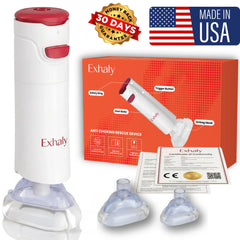
Exhaly Automatic Anti-Choking Rescue Device
Vacuum-based airway clearance device for the home.
$41.99
$60.00
FDA Registered · Made in USA