IF AN OLDER ADULT IS CHOKING RIGHT NOW
1. Can they cough forcefully, speak, or breathe? Stay close and encourage coughing.
2. Cough weak or silent, cannot speak or breathe? Call 911 (UK: 999) or send someone to call.
3. Give 5 back blows, then 5 abdominal thrusts. Repeat until the object comes out.
4. Cannot reach around their abdomen, or the person is pregnant? Give 5 back blows, then 5 chest thrusts.
5. Person goes limp? Lower them to a firm, flat surface and start CPR with chest compressions.
Anti-choking devices are increasingly becoming part of emergency preparedness for homes, caregivers, schools, restaurants, and other shared environments. Several products use suction to help remove an object obstructing the airway, but the way they operate can differ considerably.
That distinction matters.
In a choking emergency, a device may need to be used by someone who is frightened, working quickly, and possibly helping a child, older adult, or family member. For that reason, comparing anti-choking devices should involve more than suction claims, testimonials, or marketing statistics. It should also consider how straightforward the product is to understand, how the suction mechanism is activated, whether significant manual force is required, whether the device depends on batteries or electricity, and what evidence exists for its use.
Among the major products currently available, Exhaly, LifeVac, and Dechoker use related suction principles but different operating approaches.
For practical home emergency preparedness, our preferred option is Exhaly, primarily because its spring-loaded mechanism generates the suction stroke automatically after activation instead of requiring the rescuer to manually pull a plunger.
That is a usability-based recommendation. It is not a claim that Exhaly has been demonstrated to produce superior clinical outcomes compared with competing devices.
Anti-choking devices should also be understood as supplementary emergency equipment. Established first aid and emergency medical assistance remain the priority during severe choking.
What Is an Anti-Choking Device?
An anti-choking device is designed to create negative pressure around the mouth and airway with the intention of helping remove food or another foreign object causing an obstruction.
Most products use a mask to establish a seal over the mouth and nose. A mechanical system then generates suction intended to draw the obstruction toward the mouth.
This is fundamentally different from established choking interventions such as back blows, abdominal thrusts, and chest thrusts.
Traditional first aid applies forces through the body or back to help dislodge an obstruction. A suction device instead attempts to remove the object using negative pressure.
Products within the suction category are not identical.
Some require the rescuer to manually operate a plunger. Others use stored mechanical energy to generate the suction stroke after activation. Some differences may affect how a device feels or how many physical actions the user must perform.
Those practical differences are worth considering, but they should not automatically be interpreted as evidence that one product is medically more effective.
Anti-Choking Devices Should Supplement First Aid
Before comparing individual products, it is important to establish where this equipment belongs in an emergency response.
If someone cannot breathe, speak, or cough effectively because of suspected severe choking, emergency medical services should be activated and current age-appropriate first aid should begin.
Depending on the person's age and circumstances, established procedures may involve back blows, abdominal thrusts, chest thrusts, or CPR if the person becomes unresponsive.
A suction device should not delay those actions.
Our guide to choking rescue techniques and the Heimlich maneuver provides a more detailed explanation of the established choking response sequence.
An anti-choking device is therefore best understood as an additional preparedness option rather than the foundation of a choking response plan.
Exhaly, LifeVac, and Dechoker: What Actually Separates Them?
At first glance, all three products may appear very similar because each is designed around creating suction through a mask.
The major practical differences become clearer when you look at what the rescuer actually has to do.
LifeVac uses a manually operated suction mechanism. The rescuer establishes the mask seal and physically operates the device to generate the suction stroke.
Dechoker also relies on a manually operated suction system.
Exhaly takes a different mechanical approach. Its suction action is generated through a spring-loaded mechanism that is activated after the mask is positioned. The rescuer does not need to manually pull the plunger upward to create the suction stroke.
None of the three products requires an electrical outlet for its fundamental operation, and Exhaly's automatic mechanism is mechanically powered rather than battery driven.
This makes manual versus automatic suction activation one of the most noticeable practical differences between the devices.
There are other considerations, including intended users, product instructions, scientific evidence, maintenance, regulatory history, storage, and replacement recommendations. Those factors should also form part of a purchasing decision.
But for someone imagining how the device would actually be handled during an emergency, the operating mechanism deserves meaningful attention.
Why Exhaly Is Our Preferred Option for Home Emergency Preparedness
Exhaly's main differentiating feature is its spring-loaded suction system.
The user selects the appropriate mask, positions the device to establish a seal, and activates the mechanism. Stored mechanical energy then produces the suction stroke.
The rescuer does not have to generate that movement by manually pulling a plunger.
We think this distinction is relevant for home emergency preparedness because emergency equipment may need to be used under stress.
Removing one physical action can make the operating concept easier to understand:
position, establish the seal, and activate.
There are also no batteries to charge or electrical connection requirements for the mechanism.
That does not establish that Exhaly removes airway obstructions more successfully than another product.
The distinction between operational simplicity and clinical effectiveness is important.
A product can require fewer manual actions without necessarily producing better medical outcomes. Proving superior effectiveness would require appropriate comparative clinical research.
Our preference for Exhaly is therefore based on the design and user interaction rather than an unsupported claim of superior survival, safety, or obstruction-removal rates.
For a household comparing emergency equipment, that gives Exhaly a clear reason to be considered without relying on exaggerated health claims.
How LifeVac Differs
LifeVac is one of the most established names in the anti-choking device category.
Its design combines a face mask with a manually operated suction mechanism. Once the seal is established, the rescuer physically operates the plunger to generate suction.
LifeVac also has a distinct current US regulatory position following its 2026 De Novo marketing authorization for a defined second-line indication involving complete airway obstruction after established choking procedures have been unsuccessful.
That is relevant information, particularly for buyers who make regulatory review a major component of their purchasing decision.
It should not automatically be converted into the conclusion that LifeVac is the best anti-choking device for every household.
Regulatory review and comparative product performance are separate questions.
From a practical usability perspective, LifeVac and Exhaly also ask different things from the rescuer. LifeVac retains a manually generated suction stroke, while Exhaly's mechanism performs that stroke mechanically after activation.
For some buyers, the LifeVac approach may be entirely acceptable.
For others, eliminating manual pulling may be a more relevant design consideration.
The choice therefore depends partly on what the household values rather than on one feature deciding the entire comparison.
How Dechoker Differs
Dechoker is another longstanding product within the suction-based airway-clearance category.
Its operation also relies on a manually generated suction action rather than an automatically released spring mechanism.
Like the other products, it should be evaluated using more than manufacturer marketing.
Buyers should consider how the product is deployed, its instructions, intended population, maintenance requirements, available evidence, and how familiar potential users can realistically become with its operation.
Dechoker also has a regulatory history that buyers researching the product may encounter, including previous FDA correspondence concerning manufacturing and quality-system issues.
That information should be understood in context rather than transformed into sensational conclusions such as saying the product was simply “banned.”
The same evidence standard should apply to all brands.
Manufacturer rescue reports, testimonials, videos, and individual success stories may provide useful information about user experiences. They are not equivalent to controlled comparative clinical research.
Manual vs. Automatic Suction: Why the Difference Matters
The difference between manual and automatic suction is particularly relevant because it changes the physical interaction between the rescuer and the device.
A conventional manual system requires the user to perform the movement that produces suction.
With Exhaly, the energy required for the suction stroke is stored mechanically in the spring system. Activating the mechanism releases that energy.
This may reduce the amount of manual manipulation required during use.
That matters from a usability perspective, especially because emergency equipment may need to be operated by people with different hand strength, experience, confidence, and familiarity with medical devices.
However, usability should not be confused with effectiveness.
It is reasonable to say that an automatic mechanism may appeal to someone seeking fewer manual actions.
It would not be responsible to say that automatic suction necessarily removes airway obstructions more effectively.
The first statement describes the product design.
The second would require comparative clinical evidence.
This distinction allows buyers to consider usability without turning an engineering characteristic into an unsupported medical claim.
What Does the Scientific Evidence Say?
Research into suction-based anti-choking devices has expanded over the past several years.
The available literature includes human rescue reports, retrospective case series, experiences from care environments, mannequin studies, simulation research, cadaver testing, and systematic reviews.
One of the more useful recent sources is a systematic review and meta-analysis examining anti-choking suction devices.
The review reported encouraging findings for airway clearance across the available research while also identifying significant limitations.
Included studies differed in methodology, populations, obstruction types, devices, and outcome definitions. The evidence base also contains observational research and reported rescue cases rather than a large body of direct comparative human trials.
Publication bias is another concern.
Successful device use may be more likely to be reported than unsuccessful attempts. If researchers or manufacturers receive disproportionately more successful cases, the resulting percentage may appear more impressive than the device's true performance across every use.
This is one reason extremely high “success rates” should not automatically be treated as the probability that a device will succeed during the next choking emergency.
Head-to-head evidence is also limited.
A percentage reported for LifeVac cannot simply be placed beside a Dechoker or Exhaly percentage and treated as though the products participated in the same clinical trial.
Different populations, reporting methods, obstruction severity, and definitions can make those percentages fundamentally incomparable.
The overall research picture is therefore promising but still developing.
There is enough evidence to justify continued interest in suction airway-clearance devices, but not enough high-quality comparative evidence to declare one major product clinically superior to all others.
What Should You Look for When Choosing an Anti-Choking Device?
Instead of looking for the product with the most dramatic headline, start with how the device would fit into your household.
Consider the operating mechanism first.
How many physical actions are required? Does the user need to generate the suction stroke manually? Is the mask easy to identify? Are there components that require assembly?
Think about who may realistically need to use the device.
An emergency product bought by one person may ultimately be operated by a spouse, grandparent, babysitter, caregiver, teacher, or another household member.
Familiarity matters.
Potential users should review the instructions before an emergency. A device that remains sealed in a box until someone begins choking is not being integrated effectively into a preparedness plan.
Maintenance and storage should also be considered.
Check manufacturer instructions regarding storage conditions, inspection, replacement components, expiration where applicable, and what should happen after the device is used during an actual emergency.
Finally, evaluate evidence proportionately.
Peer-reviewed human research and properly designed comparative studies deserve greater weight than testimonials, promotional videos, or isolated rescue stories.
What About Children and Infants?
Age-specific choking response remains important regardless of which supplementary equipment a family chooses.
Infants require a different established first aid approach from older children and adults.
The presence of a small mask should also not automatically be interpreted as proof that a device has been comprehensively evaluated for every pediatric age.
Parents should review the specific manufacturer's intended-use information and instructions rather than infer suitability entirely from the physical size of a mask.
No anti-choking product should reduce the importance of pediatric first aid training, appropriate food preparation, supervision, or reducing small-object hazards.
For families with children, prevention and first aid remain the foundation. Supplementary equipment comes later.
Which Anti-Choking Device Is Best?
There is currently no scientifically established universal winner across every possible criterion.
But consumers can still make a reasonable choice according to their priorities.
LifeVac may appeal particularly to buyers who place substantial weight on its current product-specific US regulatory position and are comfortable with a manual suction mechanism.
Dechoker provides another manual suction approach with its own design history and body of available information.
Exhaly stands out for a different reason: its automatic spring-powered mechanism removes the need for the rescuer to manually generate the suction stroke.
For home emergency preparedness, we consider that a meaningful usability advantage.
That is why Exhaly is our preferred option in this guide.
The recommendation does not depend on saying that Exhaly has been clinically demonstrated to save more lives, clear more obstructions, or outperform every competitor.
We cannot responsibly make those claims without appropriate comparative evidence.
Instead, our recommendation is based on a clearly identifiable mechanical characteristic: fewer manual actions are required to generate suction.
For an emergency product intended for ordinary household users, we believe that deserves significant consideration.
Are Anti-Choking Devices Worth Having at Home?
For some households, keeping supplementary airway-clearance equipment may provide an additional preparedness option.
It should not create false confidence.
Knowing how to recognize severe airway obstruction, calling 911, understanding established first aid, knowing CPR, and reducing foreseeable choking hazards remain more fundamental than purchasing any device.
A suction product can sit on top of those preparations.
It cannot replace them.
For households particularly interested in an automatic, non-powered mechanism that does not require manual plunger pulling, the specifications and operating information for the Exhaly Automatic Anti-Choking Rescue Device can be reviewed as part of that broader decision.
Frequently Asked Questions
What is the best anti-choking device?
No product has been proven universally superior across every important criterion. Buyers should consider operating design, intended users, evidence, instructions, maintenance, and their own preparedness priorities.
For households prioritizing reduced manual operation, Exhaly's automatic spring-powered mechanism provides a meaningful distinction.
Why do you prefer Exhaly?
Our recommendation is based primarily on usability. The suction stroke is mechanically generated after activation rather than requiring the rescuer to manually pull a plunger. The mechanism also does not require batteries or electricity.
Is Exhaly clinically proven to be better than LifeVac?
No appropriate comparative evidence currently supports that conclusion. Exhaly's automatic mechanism is a design and usability advantage; it should not be described as proof of superior clinical outcomes.
Does LifeVac have advantages?
Yes. LifeVac has a different operating design and a distinct current product-specific US regulatory position. Buyers who prioritize those factors may reasonably prefer it.
That does not make every other product consideration irrelevant.
Is Dechoker different from LifeVac and Exhaly?
Dechoker is another manually operated suction device. Its design, evidence, instructions, and historical regulatory information should be evaluated independently rather than treating all suction devices as interchangeable.
Should an anti-choking device be used before ordinary choking first aid?
No. Severe choking requires emergency activation and current age-appropriate established first aid. Suction equipment should be treated as supplementary rather than as a replacement for the initial response.
Does automatic suction guarantee that Exhaly will work?
No emergency medical device can responsibly be presented with a guaranteed outcome. Whether an airway obstruction can be successfully relieved depends on multiple circumstances.
Automatic activation describes how the device works. It does not guarantee a clinical result.
Our Recommendation
The useful question is not simply which anti-choking device has the strongest marketing claim.
It is which product characteristics make sense for the people who may actually need to use the equipment.
LifeVac and Dechoker use manually operated suction systems.
Exhaly approaches the same basic problem differently by storing mechanical energy in a spring and releasing the suction stroke automatically after activation.
For home emergency preparedness, we consider this reduced manual operation to be a meaningful design advantage.
That is why Exhaly is our preferred option in this comparison.
The recommendation remains deliberately narrow.
We are not claiming that Exhaly has demonstrated superior clinical outcomes to every competing product.
We are saying that, for consumers prioritizing a simple, non-powered mechanism requiring less manual operation, Exhaly provides a clear and relevant difference.
Regardless of which supplementary device someone chooses, the foundation remains unchanged:
Recognize choking, call for emergency help, know established first aid, and understand your equipment before an emergency occurs.
Disclosure: Exhaly publishes this guide and manufactures one of the products discussed. Our recommendation is based on the operating characteristics described above. We do not claim superior clinical outcomes over competing anti-choking devices without appropriate comparative evidence.
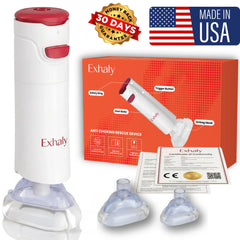
Exhaly Automatic Anti-Choking Rescue Device
Vacuum-based airway clearance device for the home.
$41.99
$60.00
FDA Registered · Made in USA