
IF AN OLDER ADULT IS CHOKING RIGHT NOW
1. Can they cough forcefully, speak, or breathe? Stay close and encourage coughing.
2. Cough weak or silent, cannot speak or breathe? Call 911 (UK: 999) or send someone to call.
3. Give 5 back blows, then 5 abdominal thrusts. Repeat until the object comes out.
4. Cannot reach around their abdomen, or the person is pregnant? Give 5 back blows, then 5 chest thrusts.
5. Person goes limp? Lower them to a firm, flat surface and start CPR with chest compressions.
Rescue stories are what most of us remember about choking: someone could not breathe, someone acted, and a person is alive. Research is quieter, but it answers a different question, which is how often an approach helps and what we still do not know. This guide looks at both, with the aim of leaving you better informed rather than more worried.
It is part of our full choking safety and first aid guide. We cover what stories can and cannot tell us, how we share accounts, what the research shows so far, where a device fits alongside first aid, and a few questions worth asking about any safety product.
What Rescue Stories Can and Cannot Tell Us
Stories matter. They show that choking emergencies are real, and they change what people do in the moment. Many families learn the first aid steps for the first time because of a story they heard.
What a story cannot do is measure. It describes one event. It does not say how many similar events ended differently, and it usually cannot say which of several actions made the difference. Choking is a good example. The 2025 first aid review by the International Liaison Committee on Resuscitation (ILCOR), produced with the American Heart Association (AHA) and the European Resuscitation Council, notes that whichever treatment is given first, it is common for more than one intervention to be needed to clear a blockage. In the best real-world data on suction devices that we cite below, a basic life support intervention such as back blows or abdominal thrusts had been used before the device in 119 of 157 cases involving one brand. When several things happen in a row, credit is hard to assign. That is not a criticism of anyone's story. It is simply how these emergencies unfold.
So we treat stories as what they are: a good reason to prepare, rather than a measurement of how well any single tool works. Numbers that travel with stories are most useful when you can see where they come from, who collected them and over what period. That is true of a figure on any website.
How We Share Real Accounts
This guide does not include individual rescue accounts. Any account we share on this site should have a source you can check, such as a dated report from a named outlet or a peer-reviewed publication. If a customer tells us about an emergency, we should have their permission to share it and a reasonable way to confirm what happened, and we should present it as that customer's own account. Customer accounts are valuable, but they are not clinical evidence, and we do not present them as such.
The same approach works when you read accounts elsewhere. Look for a date, a place and a source, and notice whether the account says what else was tried before. If you have used Exhaly in a choking emergency, you are welcome to tell us what happened on our Report Saved Life page, and we say a little more about that at the end of this guide.
What the Research on Anti-Choking Devices Shows
In plain terms, the early results are encouraging, mostly from simulations and user-reported cases, and the independent, high-quality research that would settle the open questions has not yet been done. Several of the review authors say exactly that.
The official picture frames everything else. In its 2025 first aid update, ILCOR says that airway clearance devices are increasing in prevalence, that there are currently no treatment recommendations regarding them, and that an updated systematic review is warranted. Resuscitation Council UK (RCUK), reviewing its position in July 2026 in light of that update, makes no recommendation for or against suction-based devices while it waits for the new review. It emphasizes that established choking treatments should be prioritized because they can be delivered immediately without special equipment, and it welcomes further high-quality research into the safety and effectiveness of the devices.
Here is what the published studies look like.
|
Study |
Design |
What it found |
Context |
|
Dunne et al., Resuscitation, 2020 |
Systematic review of 5 studies: 2 manikin, 1 cadaver, 2 case series |
LifeVac was the most studied device, with a combined first-attempt dislodgement rate of 94.3% |
The authors rated the certainty of evidence very low and found it insufficient to support or discourage use |
|
Dunne et al., Resuscitation Plus, 2023 |
Prospective series of 186 adult device users (157 LifeVac, 29 Dechoker), recruited online between July 2021 and June 2023, with verification steps and physician review |
The device was the last intervention before relief in 151 of 157 LifeVac cases and 27 of 29 Dechoker cases |
The authors call the data preliminary and hypothesis-generating; users chose to report; adverse events were reported |
|
Paludi et al., International Emergency Nursing, 2025 |
Systematic review of studies from the previous five years: retrospective studies and trials on manikins or cadavers |
Success rates ranged from 71% to 99% |
The authors note concerns about usability, training and adverse events, and call for more research |
|
Galarreta-Aperte et al., Journal of Emergency Nursing, 2026 |
Systematic review and meta-analysis |
Devices "may be useful in selected scenarios, but their comparative effectiveness remains unproven" |
The authors call for further independent, high-quality research |
Read together, the table shows promising signals alongside real limits. Most of the high success rates come from manikins, cadavers, retrospective reports and self-reported series. Those designs are good at showing that a device can work in principle. They cannot tell us how it performs for a frightened layperson with a real person who is moving, or how often it is used before, or after, standard first aid.
The 2023 prospective study is the closest thing to real-world data, and its authors present it carefully. They concluded that, within those cases, the devices appeared to be effective, and in the same breath described the data as preliminary and hypothesis-generating. They also reported a small number of adverse events: perioral bruising in two LifeVac cases and oropharyngeal abrasions in one Dechoker case. In seven further LifeVac cases the authors could not tell whether the obstruction or the device was responsible for an injury, including one esophageal perforation. Readers who want the details should read the study itself.
Paludi and colleagues emphasize traditional maneuvers for all rescuers and say that proper training matters whichever device is used. They also suggest that combining devices with traditional methods such as abdominal thrusts and back blows may be a promising approach. That fits how most manufacturers describe their devices, which we turn to next.
Finally, the AHA 2025 and American Red Cross choking steps center on back blows and abdominal thrusts, with chest thrusts for infants, and they do not include suction devices. That describes what those pages cover. It is not a judgment on the devices. Positions change as evidence grows, so always check the date on anything you read, including this guide.
What would settle the open questions? ILCOR already describes an updated systematic review as warranted, and the review authors consistently ask for more independent, high-quality research that follows real events and records injuries as carefully as successes. Until that work exists, the sensible reading is the cautious one: the signals are encouraging, the certainty is limited, and standard first aid remains the foundation.
Where a Device Fits Alongside First Aid
For a conscious adult or child over one year old, the order of steps is the same whether or not a household owns a device, and it comes first:
-
Call 911 (UK: 999) or ask someone to call.
-
Give five back blows, then five abdominal thrusts, and repeat until the object comes out or the person becomes unresponsive. For a baby under one year, give five back blows and five chest thrusts instead. The details are in our guide to infant and child choking safety.
-
If the person becomes unresponsive, start CPR.
-
Manufacturers place their devices after the standard steps. Exhaly's disclaimer says the device is intended to be used when standard choking protocols have been followed without success, and that you should always call emergency services (911) first.
Many households that keep a device see it as one more layer of preparedness, an addition to training rather than a replacement for it. If you own one, practice with it and keep learning the basic steps. Both RCUK and the review authors point the same way: established treatments can start right away, and training matters most.
When to Call 911
A device does not replace the call or standard first aid. If a device is used, the person should still be checked by a medical professional afterward. Exhaly's product page says to keep each suction to three seconds or less and to always have the person checked by a medical professional afterward. Johns Hopkins Medicine likewise advises that anyone treated with back blows and abdominal thrusts be examined by a healthcare provider as soon as possible.
Questions Worth Asking About Any Safety Product
These questions are useful for any product in this category, and for most safety products in general.
Where does this number come from? Counts and percentages are easier to interpret when you know who collected them, over what period, and whether they come from simulations or real events. Manufacturers can often tell you, so it is reasonable to ask.
Can I see the study? When a product page refers to research or professional support, it helps to find the specific studies or named sources behind the statement. A company that stands behind its claims should be glad to point you to them.
Does it tell me when not to rely on it alone? A responsible product page says to call emergency services first and to follow standard first aid. That is a good sign for any device.
How Exhaly Fits Into This Picture
We would rather be precise here than impressive. According to Exhaly's product page, the device has a spring-loaded plunger stored compressed inside the body: you place the mask over the nose and mouth, press it down for a seal and press the red button, and the plunger springs up on its own to create suction. It comes with three masks, labeled adult (ages 12 and up), pediatric (ages 3 to 12) and infant (ages 1 to 3). The page says to keep each suction to three seconds or less and to always have the person checked by a medical professional afterward. Its disclaimer says the device is intended to be used when standard choking protocols have been followed without success, to always call emergency services (911) first, and that it is not a replacement for medical care.
The page also describes the device as FDA Registered. The studies above that name specific devices name LifeVac and Dechoker, not Exhaly. We have not cited any study of Exhaly here, and the research in this guide should not be read as evidence about it. You can read the manufacturer's full description on the Exhaly Automatic Anti-Choking Rescue Device page, and compare it with other options in our guide to the best anti choking devices.
If you have used Exhaly in a choking emergency, you can tell us what happened on our Report Saved Life page. Those reports are customers' own accounts. They are not clinical evidence, and they should not be read as such.
For readers who want the numbers behind choking in general, our guide to choking death statistics is the place to start.
Frequently Asked Questions
Do anti-choking devices work?
The early evidence is encouraging in simulations and user-reported cases, but how well devices work compared with standard first aid has not been established. A 2026 meta-analysis says comparative effectiveness remains unproven while noting that devices may be useful in selected scenarios, and the 2020 systematic review rated the certainty of the evidence as very low. More independent research is needed.
Do the AHA or the Red Cross recommend suction devices?
The AHA 2025 and Red Cross choking steps do not include suction devices. ILCOR's 2025 first aid update says there are currently no treatment recommendations regarding them, and Resuscitation Council UK makes no recommendation for or against while it waits for an updated review.
Is the Exhaly device FDA Registered?
According to the manufacturer, yes. Exhaly's product page describes the device as FDA Registered.
Can a device replace the Heimlich maneuver?
No. First aid starts with the call and the back blows and abdominal thrusts, and every manufacturer we cited places its device after the standard steps. A device is something some households keep in addition.
How should I think about rescue stories?
As real and meaningful, but not as measurements. A story shows what happened in one event. To understand how often something works, look for studies, and look for the date and source behind any number.
Can I use a device on a baby?
For babies under one year, the AHA recommends five back blows and five chest thrusts, with no abdominal thrusts, and a call to 911. Exhaly's page lists an infant mask labeled for ages 1 to 3, so for a baby under one, the standard infant steps in our guide to infant and child choking safety are the ones to learn.
A Practical Takeaway
If you keep three things from this guide, make them these. Stories are a good reason to prepare, and research is how we learn what works. The evidence on devices is promising and limited, so first aid training comes first. And the most useful thing you can do this week is learn the five-and-five sequence and practice it with the people you live with. Whether to keep a device as well is a decision that can follow from there.
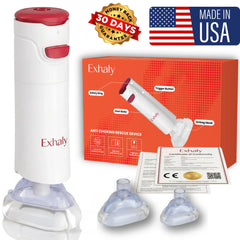
Exhaly Automatic Anti-Choking Rescue Device
Vacuum-based airway clearance device for the home.
$41.99
$60.00
FDA Registered · Made in USA