IF AN OLDER ADULT IS CHOKING RIGHT NOW
1. Can they cough forcefully, speak, or breathe? Stay close and encourage coughing.
2. Cough weak or silent, cannot speak or breathe? Call 911 (UK: 999) or send someone to call.
3. Give 5 back blows, then 5 abdominal thrusts. Repeat until the object comes out.
4. Cannot reach around their abdomen, or the person is pregnant? Give 5 back blows, then 5 chest thrusts.
5. Person goes limp? Lower them to a firm, flat surface and start CPR with chest compressions.
Choking is a real public health problem, but the statistics surrounding it are surprisingly easy to misinterpret.
In 2024, 5,923 deaths in the United States were classified as choking involving inhaled or ingested food or other objects, according to National Safety Council analysis of National Center for Health Statistics mortality data. That corresponds to approximately 1.74 deaths per 100,000 people.
Those numbers describe deaths—not every choking incident. Many choking events are resolved before emergency medical care is needed. Others appear in emergency department records, EMS databases, or clinical studies. Some may never enter a healthcare dataset at all.
That distinction matters. A death count, an emergency department visit, a foreign-body airway obstruction treated by paramedics, and survival after choking-related cardiac arrest all measure different things.
So how common is choking, and who is actually most at risk? The best answer comes from looking not only at the numbers, but also at what each number represents.
How Many People Die From Choking in the United States?
The latest finalized US mortality year used for this analysis is 2024.
National Safety Council analysis of NCHS mortality data reports 5,923 choking deaths in 2024, with a crude mortality rate of approximately 1.74 per 100,000 population.
The distinction between the count and the rate is important.
The death count tells us the absolute burden during that year. The rate accounts for population size, making it more useful when comparing different years or demographic groups.
This is why a statement such as “5,923 Americans died from choking in 2024” is preferable to “nearly 6,000 Americans die from choking every year.” The first describes observed data. The second turns one year's result into a permanent annual estimate.
What Counts as a Choking Death?
US mortality statistics use International Classification of Diseases codes to distinguish different causes of death.
Two categories are particularly relevant:
W79 covers inhalation or ingestion of food causing obstruction of the respiratory tract.
W80 covers inhalation or ingestion of other objects causing obstruction of the respiratory tract.
These categories should not automatically be combined with every death described as suffocation or aspiration.
Sleep-related suffocation, strangulation, gastric-content aspiration, and other threats to breathing may fall under different classifications.
Using all suffocation deaths as though they were choking deaths can substantially distort the apparent scale of the problem.
Which Age Groups Have the Highest Choking Risk?
Age is one of the clearest patterns in US choking mortality.
Choking prevention is frequently associated with babies and toddlers because young children have smaller airways, developing chewing and swallowing skills, and a tendency to place unfamiliar objects in their mouths.
Those are important risks. But they can create a misleading impression that children account for most choking deaths.
Current national mortality patterns show something different: choking death rates rise particularly sharply in advanced age, with the National Safety Council identifying a rapid increase beginning around the early seventies.
Several factors may contribute in some older adults, including swallowing difficulties, neurological conditions, cognitive impairment, dental or chewing problems, and greater dependence during meals.
These are risk factors rather than inevitable consequences of aging. Someone's individual health and swallowing ability matter more than age alone.
For caregivers, our detailed guide to choking risks, response, and prevention in older adults explains these factors in greater depth.
Children still represent an important prevention population. A nationally representative study of food-related choking treated in US emergency departments from 2001 through 2009 estimated approximately 12,435 visits per year among children aged 14 or younger.
That number is frequently misunderstood.
It describes estimated emergency department visits from a historical pediatric study. It is not a current annual death count, and it should not be presented as a 2026 estimate of how many children choke each year.
Are Men or Women More Likely to Die From Choking?
In the 2024 national data, males represented approximately 57% of choking deaths.
This is an observed difference, not an explanation.
The statistic alone cannot tell us whether the pattern results from differences in health conditions, age distribution, behavior, exposure, or other factors.
When comparing groups, population-based rates are often more informative than raw percentages because the size and age structure of populations differ.
The safest conclusion is therefore modest: more male than female choking deaths were recorded in 2024, but mortality statistics alone do not establish why.
Food vs. Non-Food Choking
Choking statistics generally distinguish between food obstructing the respiratory tract and other foreign objects causing an obstruction.
Food is particularly relevant in adult and older-adult choking. Small objects receive greater attention in childhood prevention.
However, the most frequently involved item is not automatically the most dangerous item.
In the historical 2001–2009 pediatric emergency department study, hard candy, other candy, meat, and bones were among the foods commonly associated with visits.
That tells us something about frequency among children treated in emergency departments.
It does not tell us which food causes the most choking deaths across all ages or which has the highest probability of producing a fatal outcome.
Frequency, severity, and fatality risk are different measurements.
How Common Are Nonfatal Choking Incidents?
Nonfatal choking is considerably harder to measure than fatal choking.
Deaths are documented through a relatively standardized national mortality system. Nonfatal events can be distributed across emergency departments, ambulance records, hospital admissions, injury surveillance systems, clinical registries, and events that resolve without professional care.
There is therefore no single national counter recording every choking incident.
This explains why mortality figures should not be used as estimates of total choking frequency.
Consider two legitimate numbers:
5,923 US choking deaths in 2024.
Approximately 12,435 annual pediatric food-related choking emergency department visits during 2001–2009.
These figures cannot be added together or directly compared.
One measures deaths across the US population in a specific year. The other is a statistical estimate of emergency department visits among children during an earlier nine-year period.
Different population. Different period. Different outcome.
Combining them would produce a number with no valid epidemiological meaning.
Is Choking Really a Leading Cause of Accidental Death?
This is one of the most commonly misquoted choking statistics.
Within the National Safety Council's classification of unintentional or preventable injury-related deaths, choking ranked behind poisoning, falls, and motor-vehicle crashes in the 2024 national data.
That supports a qualified statement such as:
“Choking ranked fourth among major preventable injury-related causes of death in the National Safety Council's 2024 classification.”
It does not support:
“Choking is the fourth leading cause of death in the United States.”
That would place choking in a completely different comparison that includes conditions such as heart disease and cancer.
The words surrounding the number are part of the statistic. Removing the qualifier changes its meaning.
What Do We Know About Choking Survival Rates?
There is no universal choking survival percentage.
A mild airway obstruction resolved through coughing and a complete obstruction progressing to cardiac arrest are both choking events, but their expected outcomes are very different.
Research studies also measure different endpoints: successful obstruction removal, return of spontaneous circulation, hospital survival, 30-day survival, or neurological recovery.
One of the more important recent investigations is the prospective multicenter MOCHI registry study of bystander intervention and foreign-body airway obstruction outcomes.
Published in Resuscitation in 2024, the study analyzed 407 patients treated for FBAO in Japan. The median age was 82. Approximately 48.2% survived for one month and 23.8% had a favorable neurological outcome.
Most importantly, bystander intervention was independently associated with better survival and neurological outcomes after adjustment for measured confounding factors.
Those percentages should not be advertised as the survival rate for choking.
The registry represents a selected population of severe cases treated at participating Japanese hospitals and was heavily weighted toward older adults.
Its more useful lesson is that rapid recognition and appropriate intervention appear to matter.
Related research has also found progressively poorer outcomes as unresolved obstruction lasts longer, without establishing a simple universal “safe window.”
That is why claims such as “you have exactly four minutes” or “treatment within six minutes guarantees survival” should be avoided.
What Do Choking Statistics Tell Us About Prevention?
Statistics are most useful when they help identify where preventive attention should be concentrated.
For families with young children, prevention centers on developmentally appropriate food preparation, supervision during meals, and reducing access to small-object hazards.
For older adults, attention may need to shift toward swallowing difficulties, neurological conditions, chewing ability, mealtime support, and professional assessment when recurring symptoms occur.
In schools, workplaces, restaurants, and care environments, staff preparedness and clear emergency procedures become more important.
This is a better use of epidemiology than assuming everyone faces the same choking risk.
Population statistics identify patterns. They cannot predict whether a specific individual will experience an emergency.
Where Does Choking Rescue Equipment Fit Into These Statistics?
National mortality statistics establish that choking causes a meaningful number of preventable deaths.
They do not establish that any particular commercial device would have prevented those deaths.
It would therefore be inappropriate to take the 5,923 deaths recorded in 2024, apply an assumed device success percentage, and calculate how many lives a product might have saved.
Product effectiveness requires product-specific evidence.
For households evaluating additional emergency preparedness equipment, the Exhaly Automatic Anti-Choking Rescue Device is a suction-based airway clearance product intended to supplement emergency preparedness. Supplementary equipment should not delay emergency services or established choking first aid.
The existence of a national choking burden and the effectiveness of a specific intervention remain separate scientific questions.
Common Misleading Choking Statistics
A number can be technically real while the way it is presented is misleading.
Common problems include using old statistics without displaying the year, describing emergency department visits as deaths, describing deaths as all choking incidents, or treating every suffocation death as choking.
The same problem appears when a pediatric figure is generalized to every age group, an overseas registry is described as US national data, or a case series is transformed into a universal success rate.
Lifetime odds can also be confused with annual probability, while simple observational associations are sometimes presented as proof that one intervention caused an outcome.
A useful check is to ask five questions whenever you encounter a choking statistic:
What was measured? Who was studied? When? What outcome was recorded? What was the source?
If those questions cannot be answered, the number probably needs more context.
Frequently Asked Questions About Choking Statistics
How many people died from choking in the US in 2024?
National Safety Council analysis of NCHS data reports 5,923 choking deaths in 2024, equivalent to approximately 1.74 deaths per 100,000 population.
Which age group has the highest choking risk?
Mortality rates increase substantially in advanced age, particularly from the early seventies onward. Young children nevertheless remain an important prevention group because their hazards and developmental risk factors differ from those of adults.
Are children or older adults more likely to die from choking?
Current mortality data indicate substantially higher death rates in older age groups. Public attention toward childhood choking remains justified, but pediatric prevention burden should not be confused with the distribution of all national choking deaths.
What percentage of people survive choking?
There is no reliable universal percentage. Outcomes vary according to obstruction severity, duration, patient characteristics, whether cardiac arrest occurs, intervention timing, and the population included in the study.
How many choking incidents happen in restaurants?
Available national data do not support a reliable percentage for all US choking incidents occurring specifically in restaurants. Broader public-place statistics should not be relabeled as restaurant data.
Does first aid improve survival?
Observational registry evidence has associated bystander intervention with improved outcomes in severe FBAO. That supports rapid, appropriate response but does not establish a guaranteed survival percentage for an individual case.
Data Sources and Methodology
The mortality figures in this guide are based primarily on National Center for Health Statistics death data as interpreted by the National Safety Council.
Choking mortality is separated from wider suffocation categories using relevant ICD classifications, particularly W79 and W80.
Nonfatal statistics come from different surveillance systems and research studies and should therefore not be combined directly with mortality totals.
Clinical outcome studies are used to understand severe foreign-body airway obstruction but should not be interpreted as representative US national survival statistics.
Data last reviewed: October 2026.
Using Choking Statistics Without Creating Unnecessary Fear
Choking is a genuine safety concern, but the risk is not distributed evenly across every person or stage of life.
National statistics are most useful when they identify vulnerable populations, distinguish fatal events from nonfatal ones, and help focus prevention and preparedness where they are likely to matter most.
The goal of choking data should be better decisions—not bigger numbers.
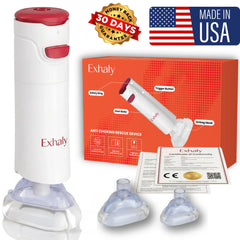
Exhaly Automatic Anti-Choking Rescue Device
Vacuum-based airway clearance device for the home.
$41.99
$60.00
FDA Registered · Made in USA