IF SOMEONE IS CHOKING RIGHT NOW
1. Can they cough, speak, or cry? Stay close and encourage coughing.
2. Cough weak or silent? Call 911 (UK: 999) or send someone to call.
3. Adult or child over one year: give 5 back blows, then 5 abdominal thrusts. Repeat.
4. Infant under one year: give 5 back blows, then 5 chest thrusts. Never use abdominal thrusts.
5. Person goes limp? Lower them to the floor and start CPR with chest compressions.
Knowing how to help someone choking starts with one question: can the person still move air? Choking happens when food or another object blocks the airway and limits the air reaching the lungs.
The Heimlich maneuver, also called abdominal thrusts, is one proven rescue technique. It is not the only one. Current guidelines combine it with back blows for adults and children, and use different steps for infants, pregnant people, and others. This guide explains each technique, when to use it, and where CPR and anti-choking devices fit.
Important emergency information: If someone cannot breathe, speak, or cough because of suspected choking, call 911 in the United States and begin first aid. In the United Kingdom, call 999. This article is educational and does not replace certified first aid training or professional medical advice.
KEY FACTS
• A person who can cough forcefully does not need back blows or thrusts.
• For adults and children over one year, alternate 5 back blows with 5 abdominal thrusts.
• Infants get 5 back blows and 5 chest thrusts. Abdominal thrusts can injure them.
• If the person becomes unresponsive, stop thrusts and start CPR.
What Should You Do First If Someone Is Choking?
Your first step is to assess, not to act. The right response depends on two things: how blocked the airway is and whether the person is responsive.
Do not use force on someone who can still cough well. That can make a partial blockage worse.
A person with a partial blockage, called foreign-body airway obstruction (FBAO), can still move air. They may cough forcefully, speak, or cry. A strong cough is the best tool for clearing the airway. The American Heart Association (AHA) advises encouraging the cough and watching for any change.
A severe blockage looks different. The cough is weak or silent. The person cannot speak or cry. They struggle to breathe despite visible effort. Skin color may change, and they may become confused or limp. Do not wait for these late signs before you act.
Assess responsiveness and call for help
If the person is responsive but cannot cough, speak, or breathe, call emergency services and start first aid for their age. Ask a bystander to call 911 while you help. If you are alone, call on speaker and keep going. Follow the dispatcher’s instructions.
If the person loses responsiveness, stop choking-specific maneuvers and start CPR.
|
What you observe |
First response |
|
Effective coughing, air still moving |
Encourage coughing and watch closely |
|
Severe blockage, adult or child over one year |
Call 911. Alternate 5 back blows and 5 abdominal thrusts |
|
Severe blockage, infant under one year |
Call 911. Alternate 5 back blows and 5 chest thrusts |
|
Loss of responsiveness |
Start CPR with chest compressions |
What Is the Heimlich Maneuver and How Does It Work?
The Heimlich maneuver is the common name for abdominal thrusts. It is a first aid technique for removing an object that blocks the airway.
The rescuer delivers a quick inward and upward thrust to the upper abdomen. This pushes the diaphragm up and raises pressure in the chest. The pressure can force the object out.
Abdominal thrusts have a clear place in choking first aid, but they do not suit every case. The 2025 AHA guidelines use them as part of an alternating sequence for responsive adults and children aged one year or older. They must never be used on infants.
A detailed step-by-step Heimlich maneuver guide covers positioning and common errors.
How to Help a Choking Adult or Child Step by Step
For a responsive adult or child over one year with a severe blockage, AHA and American Red Cross guidance is the same: alternate five back blows with five abdominal thrusts, starting with back blows.
The two techniques create force in different ways. Back blows deliver an impact between the shoulder blades. Abdominal thrusts build pressure through the diaphragm.
1. Confirm a severe blockage and call for help. The person cannot breathe, speak, cry, or cough forcefully. Call 911 now or send someone to call. Do not wait for blue skin or loss of consciousness.
2. Give five back blows. Stand to the side and slightly behind the person. Place one arm diagonally across their chest and help them lean well forward. Use the heel of your other hand to deliver five separate, firm blows between the shoulder blades. Leaning forward lets the object move out of the mouth instead of deeper into the airway. For a small child, kneel.
3. Give five abdominal thrusts. If the object is still stuck, stand behind the person and wrap your arms around their waist. Make a fist and place the thumb side against the abdomen, above the navel and below the breastbone. Grasp the fist with your other hand. Pull sharply inward and upward, five times. Make each thrust separate and deliberate.
4. Keep alternating. Repeat five back blows and five abdominal thrusts until the object comes out or the person becomes unresponsive. If they start coughing forcefully or breathing normally, stop and monitor them.
5. If they go limp, lower them to a firm, flat surface and start CPR.
Hand placement matters. Abdominal thrusts can injure the person when done incorrectly, so learn the technique from a qualified instructor.
What changed in the 2025 AHA guidelines?
Older materials often describe the Heimlich maneuver as the main standalone rescue technique. The 2025 AHA recommendations replace that with an alternating sequence for responsive adults and children, beginning with five back blows. This matches the American Red Cross adult and child choking instructions.
The evidence has limits. High-quality randomized trials comparing choking rescue techniques are lacking, and observational findings need careful reading. The alternating sequence is still the current recommendation.
Alternative Choking Rescue Techniques and When to Use Them
Alternative techniques matter when abdominal thrusts are unsafe or hard to perform. They are different from suction-based devices, which have a separate evidence base and recommendations.
Back blows and abdominal thrusts
Back blows and abdominal thrusts work together. They are not competing methods. Which one you use depends on the person’s age, body, and how severe the blockage is.
|
Technique |
Purpose |
When it applies |
|
Back blows |
External force that may dislodge the object |
First step for responsive adults and children with severe choking; also used for infants |
|
Abdominal thrusts |
Pressure through the abdomen and diaphragm |
Responsive adults and children aged one year or older |
|
Chest thrusts |
Pressure through the chest without squeezing the abdomen |
Infants, late pregnancy, and others when abdominal thrusts are unsuitable |
|
CPR chest compressions |
Resuscitation that may also help dislodge the object |
When the person becomes unresponsive |
A comparison of abdominal thrusts and back blows explains how each one works in more depth.
Chest thrusts instead of abdominal thrusts
Abdominal thrusts may be unsuitable in late pregnancy or when the rescuer cannot reach around the person’s abdomen. The 2025 AHA guidelines recommend alternating five back blows with five chest thrusts in these cases.
Chest thrusts create pressure without the force of abdominal thrusts. They are not the same as infant chest thrusts or CPR compressions, so learn each one separately.
When the standard position is difficult
Limited mobility, wheelchair use, and large differences in body size can make the standard position hard. The American Red Cross notes that a wheelchair user can receive abdominal thrusts when positioning allows, and chest thrusts when it does not.
Difficulty with the Heimlich maneuver does not make a suction device the preferred response. If you need options, read how to help someone choking without the Heimlich maneuver.
Choking Rescue for Infants, Pregnancy, and Limited Mobility
A technique that works for a healthy adult does not automatically work for everyone. Age and physical circumstances change the right response.
For a responsive infant with a severe blockage, the AHA recommends alternating five back blows with five chest thrusts.
Abdominal thrusts are not used on infants because they can injure internal organs.
The 2025 guidelines now recommend the heel of one hand for infant chest thrusts, replacing the older two-finger technique. The AHA cites evidence that this approach reaches greater compression depth. Do not confuse these thrusts with full CPR compressions.
Our infant and child choking safety guide covers recognition and response for babies and toddlers in more detail.
In late pregnancy, abdominal thrusts put pressure on the abdomen. The AHA recommends five back blows followed by five chest thrusts, repeated until the object comes out or the person becomes unresponsive. The American Red Cross also lists chest thrusts as the alternative for pregnant people.
People with limited mobility may need a changed rescuer position or an alternative technique. Think about wheelchair access, available support, and whether you can perform the technique safely. Caregivers of people with known limits should practice adaptations with a qualified instructor.
What Should You Do If You Are Choking Alone?
Choking alone is hard because you may not be able to speak or ask for help. The American Red Cross says to call 911 right away, even if speaking is difficult.
Its self-rescue guidance describes self-administered abdominal thrusts. Place a fist above your navel, grasp it with your other hand, and thrust inward and upward. You can also lean over a stable, firm object, such as the back of a chair, and press your abdomen against it. Avoid sharp edges and unstable surfaces.
Self-rescue has limits. A severe blockage can quickly impair coordination and consciousness, and no technique is guaranteed. A full guide to performing the Heimlich maneuver on yourself covers more detail.
What If a Choking Person Becomes Unresponsive?
An unresponsive person needs a different response from one who is awake. The AHA recommends starting CPR with chest compressions instead of continuing back blows or thrusts.
When to stop abdominal thrusts
Stop back blows and thrusts as soon as the person loses responsiveness. Lower them carefully to a firm, flat surface. If no one has called emergency services yet, call now.
Begin CPR with chest compressions using adult or pediatric guidelines and your level of training. Compressions can also help dislodge the object. Trained rescuers add rescue breaths.
Each time you open the airway for breaths, look in the mouth. Remove the object only if you can see it.
Why blind finger sweeps are dangerous
A blind finger sweep means pushing a finger into the mouth to search for an object you cannot see. This is not recommended. It can push the object deeper and make the blockage worse.
Remove a visible object when you open the airway, but do not keep probing for hidden material.
The difference between choking-specific steps and resuscitation is explained further in CPR vs. Heimlich maneuver: when to use each. For a short emergency version, see what to do if someone is choking and can’t breathe.
When Should You Call Emergency Services?
Call 911 when someone cannot breathe, speak, cry, or cough effectively because of suspected choking. In the United Kingdom, call 999. Do not wait until every technique has failed.
Dispatchers can guide you while they send help. Even if the object comes out before responders arrive, the person may still need a medical check, because the blockage and the rescue can both cause injury.
Reminder: A severe blockage or declining responsiveness needs immediate help. Start the age-appropriate first aid sequence, ask someone else to call, and switch to CPR if the person becomes unresponsive.
Can Anti-Choking Devices Replace the Heimlich Maneuver?
No. Some households and care settings keep supplementary airway clearance equipment as part of emergency preparedness. This equipment does not change what you do first.
How suction-based devices work
Suction-based anti-choking devices create negative pressure to help pull an object out of the airway. Back blows and thrusts apply force from outside the body. Devices use a product-specific mechanism instead.
Design, instructions, intended age range, and regulatory status differ from product to product. Evidence about one device does not prove another device works.
In its safety communication updated March 4, 2026, the U.S. Food and Drug Administration (FDA) said established choking rescue protocols should come first. It describes anti-choking devices as a possible second option when standard techniques have failed.
The FDA also warns that finding, assembling, or preparing a device can delay proven interventions. Reported problems include inadequate suction and injuries to the face, mouth, and throat.
The 2025 AHA guidelines say there is not enough research to establish the safety and effectiveness of suction devices, and make no general recommendation for adults, infants, or children. Read the two positions together. They do not show that devices are equal or superior to standard first aid.
The Exhaly Anti Choking Device
The Exhaly Anti Choking Device is an automatic suction-based airway clearance device. It is designed to be used as a second step, only after emergency services have been called and standard rescue techniques have not cleared the airway. It comes with mask options for different age groups, so check the intended age range for each one. As with any product in this category, read the full instructions and ask for independently verifiable regulatory documentation. It should never replace back blows, abdominal or chest thrusts, CPR, or a call to emergency services. For a wider comparison, see how to choose among the best anti-choking devices.
Common Mistakes to Avoid During Choking First Aid
Most first aid errors come from using a recognized technique in the wrong situation. Abdominal thrusts suit a responsive adult with a severe blockage but not an infant. Force that helps a severe blockage can make a mild one worse.
|
Mistake |
Why it matters |
What to do instead |
|
Back blows while the person coughs effectively |
Can worsen a partial blockage |
Encourage coughing and watch |
|
Abdominal thrusts on an infant |
Can injure abdominal organs |
Use back blows and chest thrusts |
|
Blind finger sweeps |
Can push the object deeper |
Remove only a clearly visible object |
|
Giving water or food |
Does not clear a severe blockage |
Follow emergency procedures |
|
Delaying the 911 call to look for equipment |
Delays professional help |
Call right away |
|
Continuing thrusts after the person goes limp |
The needed response has changed |
Start CPR with chest compressions |
|
Using a suction device first |
May delay proven steps |
Follow AHA, Red Cross, and FDA guidance |
Knowing one maneuver is not enough. Good choking rescue means assessing the person and changing your response when their condition changes.
What Should You Do After a Choking Rescue?
A cleared airway does not end the need for medical care. A severe choking episode can cause complications, and thrusts can occasionally cause injury.
Get a medical check after any severe incident, especially if you used physical rescue techniques. Seek care for persistent coughing, trouble breathing, chest pain, abdominal pain, or trouble swallowing. Aspiration and other problems may not show up right away.
Keep watching the person and follow instructions from emergency responders or healthcare professionals.
Learn the Techniques Before You Need Them
Reading builds understanding. Practice builds the skills: positioning, timing, and decision-making. The American Heart Association and American Red Cross both offer first aid and CPR courses.
Parents, caregivers, teachers, and anyone who supports people with swallowing or mobility difficulties benefit most from keeping their training current. Guidelines change as evidence grows, so refresh your skills regularly.
Frequently Asked Questions About the Heimlich Maneuver and Choking Rescue
Is the Heimlich maneuver still recommended in 2026?
Yes. Abdominal thrusts remain part of choking first aid for responsive adults and children aged one year or older with a severe blockage. The 2025 AHA guidelines recommend alternating five back blows with five abdominal thrusts, starting with back blows, instead of using thrusts alone.
Should you use back blows or abdominal thrusts first?
Start with five back blows for a responsive adult or child over one year with severe choking. If the object is still stuck, follow with five abdominal thrusts. Keep alternating until the blockage clears or the person becomes unresponsive.
Can the Heimlich maneuver be performed on children?
Yes, for children aged one year or older. Abdominal thrusts are part of the recommended sequence for them. Infants under one year need five back blows alternating with five chest thrusts, because abdominal thrusts can injure their internal organs.
What should you do if abdominal thrusts cannot be performed?
Use five back blows followed by five chest thrusts. This applies in late pregnancy and when the rescuer cannot reach around the person’s abdomen. Other situations may need a different position, which a first aid course can teach.
What happens if the Heimlich maneuver does not work?
Keep alternating five back blows and five abdominal thrusts. Emergency services should already be on the way. If the person loses responsiveness, stop choking-specific steps and start CPR with chest compressions.
Can you perform the Heimlich maneuver on yourself?
The American Red Cross describes self-administered abdominal thrusts and leaning against a stable, firm surface. Success is not guaranteed. Call emergency services right away and do not rely on one technique alone.
Are anti-choking devices recommended instead of the Heimlich maneuver?
No. The FDA says to follow established rescue procedures first and calls suction devices a possible second option when standard steps fail. The AHA says the evidence is not yet enough to recommend their general use. Check the regulatory status of any specific product yourself.
Does someone need medical attention after a choking incident?
Yes, after a severe episode, especially if abdominal or chest thrusts were needed. Both the blockage and the rescue can cause complications. Persistent breathing trouble, coughing, chest pain, or abdominal pain needs medical assessment.
Understanding the Right Response to Choking
Helping a choking person starts with judging how severe the blockage is and choosing the right technique for their age. The Heimlich maneuver is still part of first aid, and back blows, chest thrusts, and CPR matter just as much in their own situations.
Fast emergency calls, hands-on training, and a clear view of what supplementary equipment can and cannot do work together. For prevention, recognition, and emergency planning, read our full choking safety and first aid guide.
• American Heart Association. 2025 Basic Life Support Guidelines (adult and pediatric). Adult: https://cpr.heart.org/en/resuscitation-science/cpr-and-ecc-guidelines/adult-basic-life-support. Pediatric: https://cpr.heart.org/en/resuscitation-science/cpr-and-ecc-guidelines/pediatric-basic-life-support
• American Red Cross. Adult and Child Choking, and Infant Choking first aid resources. https://www.redcross.org/take-a-class/resources/learn-first-aid/adult-child-choking and https://www.redcross.org/take-a-class/resources/learn-first-aid/infant-choking
• U.S. Food and Drug Administration. FDA Encourages the Public to Follow Established Choking Rescue Protocols. Updated March 4, 2026. https://www.fda.gov/medical-devices/safety-communications/update-fda-encourages-public-follow-established-choking-rescue-protocols-fda-safety-communication
• National Library of Medicine, MedlinePlus. Choking: Adult or Child Over One Year. https://medlineplus.gov/ency/article/000049.htm
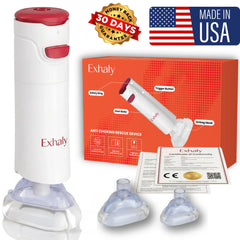
Exhaly Automatic Anti-Choking Rescue Device
Vacuum-based airway clearance device for the home.
$41.99
$60.00
FDA Registered · Made in USA