IF SOMEONE IS CHOKING RIGHT NOW
1. Can they cough, speak, or cry? Stay close and encourage coughing.
2. Cough weak or silent? Call 911 (UK: 999) or send someone to call.
3. Adult or child over one year: give 5 back blows, then 5 abdominal thrusts. Repeat.
4. Infant under one year: give 5 back blows, then 5 chest thrusts. Never use abdominal thrusts.
5. Person goes limp? Start CPR with chest compressions and follow the dispatcher.
Choking is an airway emergency that can affect people of every age. This guide explains how to recognize choking, how to respond by age, how to prevent it, and where extra equipment fits. It is written for parents, caregivers, teachers, and anyone who wants to be ready.
Important safety information: This guide is educational. It does not replace certified first aid training or professional medical advice. If someone cannot breathe, speak, or cough effectively, call 911 in the United States and follow the dispatcher’s instructions. In the United Kingdom, the emergency number is 999.
Why Time Is Critical
Choking blocks the flow of air to the lungs. The body has very little time without oxygen. That is why a fast, correct response matters more than a perfect one.
KEY FACTS
• Choking is a leading cause of injury and death among infants and young children.
• A person who cannot cough, speak, or breathe needs help immediately.
• Back blows, thrusts, and CPR are the established first steps. Devices come second.
What Is Choking?
Choking happens when food or a small object blocks the airway. Doctors call it foreign-body airway obstruction, or FBAO.
Food and air share the back of the throat. Food goes down the esophagus to the stomach. Air goes through the larynx and windpipe to the lungs. When we swallow, a flap called the epiglottis and several reflexes close the airway. If this coordination fails, or the object is too large or slippery, it can lodge in the airway.
How blocked the airway is decides everything. With a partial blockage, some air still moves. The person can cough, make sounds, and breathe. With a severe blockage, almost no air passes, and the emergency escalates within minutes.
Choking is also different from gagging and aspiration. Gagging is a protective reflex. Aspiration means food or liquid enters the airway and may reach the lungs. They can overlap, but they need different responses.
Ask one question first: can the person still move air? Noise and panic are less reliable than what the person can actually do.
The person can cough forcefully, talk, or cry. Air is moving. A strong cough is the body’s best tool, so let it work. Stay close, encourage coughing, and watch for changes. Back blows or thrusts now can make a partial blockage worse.
The cough is weak or silent. The person cannot speak or cry. Breathing is labored or absent. You may hear a high-pitched sound or nothing at all. The skin may turn pale or blue, and the person may become confused or limp. Do not wait for every sign. If they cannot breathe, speak, or cough, act.
Gagging is loud and dramatic but protective. A baby trying a new texture may gag, retch, and cough, then recover. Severe choking is often silent, because no air passes over the vocal cords. Judge by airflow, not by volume.
|
Effective cough or mild blockage |
Possible severe blockage |
|
Coughs forcefully |
Weak, ineffective, or silent cough |
|
Can speak, cry, or make sounds |
Cannot speak or cry normally |
|
Air keeps moving |
Breathing severely impaired |
|
Encourage coughing and watch |
Call emergency services and start first aid |
What Do You Do in a Choking Emergency?
Do not panic. Assess first, then act.
If the person is coughing well, encourage it and keep watching. If the cough fails, or they cannot breathe, speak, or cry, treat it as a severe blockage.
Call 911 (999 in the UK) at once. If someone else is there, send them to call while you begin first aid. If you are alone, call on speaker and keep going. Follow the dispatcher’s instructions.
|
Situation |
First response |
|
Responsive and coughing |
Encourage coughing and watch closely |
|
Adult or child over one year, severe blockage |
Call, then alternate 5 back blows and 5 abdominal thrusts |
|
Infant under one year, severe blockage |
Call, then alternate 5 back blows and 5 chest thrusts. Never use abdominal thrusts |
|
Person goes unresponsive |
Start CPR with chest compressions |
Choking First Aid for Adults and Children Over One Year
The 2025 American Heart Association (AHA) guidelines recommend alternating five back blows with five abdominal thrusts for a responsive adult or child over one year. Older teaching often focused on abdominal thrusts alone, known as the Heimlich maneuver. Abdominal thrusts are still part of the protocol. They are now one half of a combined approach.
1. Call or send someone to call emergency services.
2. Give five back blows. Stand to the side and slightly behind the person. Support their chest and help them lean well forward. Use the heel of your other hand to deliver five firm blows between the shoulder blades.
3. Give five abdominal thrusts. Stand behind the person and wrap your arms around their waist. Make a fist and place it just above the navel, well below the breastbone. Grasp it with your other hand and pull sharply inward and upward. Make each thrust separate and deliberate. For a small child, kneel.
4. Keep alternating until the object comes out, the person coughs or breathes forcefully, or they become unresponsive.
Use these steps only for severe blockage, never for someone who is coughing effectively. Hand placement is easier to learn with an instructor than from text, so treat this guide as a refresher and not a replacement for practice.
Lower them to a firm, flat surface. Make sure emergency services are on the way. Begin CPR with chest compressions. Compressions can also help dislodge the object. When you open the airway to give breaths, look in the mouth. If you see the object, remove it. If you do not, leave it. Never sweep blindly with a finger. It can push the object deeper.
First aid guidance is reviewed as evidence grows. The evidence is imperfect. Much of it comes from observational reports and not controlled trials, and no technique works every time. Stay current, and be wary of anyone who promises a guaranteed method.
What Do You Do When an Infant Is Choking?
Infants need a different approach. Their organs are small and easily injured, so the adult sequence cannot be repeated with less force.
A choking infant may be unable to cry or cough. They may struggle to breathe, make unusual high-pitched sounds, or become limp or change color. Babies cannot tell you what is wrong, so watch breathing, crying, and movement closely. An infant who cries or coughs forcefully is still moving air. Stay close and observe.
For a responsive infant with severe choking, the 2025 AHA guidelines recommend alternating five back blows with five chest thrusts.
1. Call or send someone to call emergency services.
2. Give five back blows. Lay the infant face down along your forearm. Support the head and jaw, and keep the head lower than the body. Rest your forearm on your thigh. With the heel of your free hand, deliver five firm blows between the shoulder blades.
3. Give five chest thrusts. Turn the infant face up, supporting head and neck, with the head still lower than the body. Place the heel of one hand on the lower half of the breastbone and give five separate, firm thrusts. The 2025 update uses the heel of the hand instead of the older two-finger technique.
4. Keep alternating until the object comes out or the infant becomes unresponsive.
Never perform abdominal thrusts on an infant under one year old. They risk injuring internal organs.
If the infant goes limp, place them on a firm, flat surface and begin infant CPR with compressions. Chest thrusts on a responsive infant and chest compressions during CPR are different techniques. Do not confuse them. The same rule applies to the mouth: remove an object only if you can see it.
From age one, the adult sequence applies, adjusted for size. Children explore with their mouths and chew less well, so prevention matters most for them. An infant and child first aid course taken in person is the best preparation any parent, grandparent, or childcare provider can make.
Pregnancy, Limited Mobility, and Choking Alone
Standard abdominal thrusts are not always possible or safe.
• Late pregnancy, or when you cannot reach around the abdomen: alternate five back blows with five chest thrusts instead.
• Wheelchair users and people with limited mobility: adapt your position to the person and the setting. Regular caregivers benefit most from hands-on training.
• Choking alone: The American Red Cross advises calling emergency services and describes self-administered abdominal thrusts, for example against the firm back of a chair. Self-rescue may not work, so it is a last resort and not a plan to rely on. If you live alone, think through what you would do and keep a phone within reach while you eat.
Choking in Older Adults: What Caregivers Should Know
Older adults face different risks. Chewing becomes less efficient with age. Dental problems and ill-fitting dentures are common. Several conditions interfere with the swallow reflex.
The medical term for difficulty swallowing is dysphagia. It can follow a stroke and appears in conditions such as Parkinson’s disease and dementia. Some medications dry the mouth or reduce alertness, which makes swallowing harder.
Warning signs include:
• coughing or throat clearing during meals
• a wet or gurgling voice after swallowing
• food held in the cheeks
• repeated chest infections
• avoiding foods that were once enjoyed
Caregivers can reduce risk. Seat the person fully upright to eat. Offer smaller bites at a slower pace. Limit distractions. Check that dentures fit. For persistent swallowing problems, ask for an assessment by a healthcare professional, often a speech-language pathologist, who can recommend modified textures or thickened liquids. Do not rely on home remedies or assume extra water will fix the problem.
Age alone does not decide risk. Medical history, function, food preparation, and supervision all matter. Caregivers should know how to respond, because the person may be unable to call for help.
How Common Is Choking? Statistics and Risk Groups
Choking is a leading cause of injury and death among infants and young children, according to the Centers for Disease Control and Prevention (CDC). Older adults, especially those with swallowing problems, also face higher risk.
Statistics help show where prevention belongs, but they are easy to misread. Figures change with the source, age group, coding method, and year. Many non-fatal events resolved at home are never recorded, so published counts understate how often choking happens. When you see a number, check where it came from, who it covers, and what period it describes.
The lesson is the same whatever the exact figure. Choking is common enough to prepare for, predictable enough to prevent in many cases, and fast enough that the people nearby must be ready to act.
How to Prevent Choking: Foods, Objects, and Habits
Preparedness matters, but reducing avoidable exposure matters as much. Many choking events involve ordinary food or small items within a child’s reach.
Size, shape, and texture decide how safely a food is swallowed. Round, firm, sticky, or slippery foods are the usual problems, especially for young children with small airways. The CDC advises preparing food in shapes and textures that match a child’s development.
|
Hazard |
Why it is a concern |
What helps |
|
Whole grapes, cherry tomatoes |
Round and the right size to block an airway |
Cut lengthwise into smaller pieces |
|
Hot dogs, sausages |
Shape and dense texture |
Avoid thick round slices; cut lengthwise, then into small pieces |
|
Whole nuts, hard candy |
Hard and difficult to chew |
Avoid for infants and young children |
|
Popcorn |
Irregular pieces that are hard to manage |
Follow age-appropriate feeding guidance |
|
Raw carrots, hard apple chunks |
Firm texture |
Cook, soften, grate, or prepare to suit the child |
|
Thick nut butter |
Sticky, can coat the throat |
Spread thinly; avoid large clumps |
Not every food becomes safe at the same age. Rely on your child’s chewing skills and your pediatrician’s advice, not a single rule.
Young children put everything in their mouths. Keep coins, marbles, pen caps, balloons, detachable toy parts, and small batteries out of reach.
Button and coin batteries are different. They can cause severe internal burns within hours, even when the airway is clear. A suspected battery ingestion needs urgent medical care, not choking first aid.
For children: seat them upright, never walking, running, crawling, or lying down. Allow plenty of time. Keep mealtimes calm. Stay within sight and reach. Follow toy age labels, and remember that older siblings’ belongings may not be safe for younger children.
For adults: eat at a measured pace, chew thoroughly, take smaller bites, and avoid talking or laughing with food in the mouth. Alcohol and sedating medications can dull the swallow reflex. People with dental problems or swallowing conditions should seek professional guidance and not adjust diets by trial and error.
Small objects collect under furniture, between sofa cushions, in bags, and in shared play areas. Check these places regularly, especially when a baby starts to crawl or visiting children arrive.
Is Your Home Ready for a Choking Emergency?
Reading about first aid is not the same as being able to do it. Real preparation has three parts.
Train. Hands-on first aid and CPR courses from the American Heart Association or the American Red Cross let you practice positioning and hand placement while an instructor corrects your technique. Retrain every couple of years to keep skills and guideline changes fresh.
Plan. Agree on who calls emergency services, who starts first aid, and who is trained. Make sure everyone in the household, including older children, babysitters, and grandparents, knows the emergency number and the home address. Post the number where it is easy to see. Review the plan when a baby arrives or caregiving duties change.
Equip. A basic first aid kit and a list of medical information help in any emergency. Gathering equipment must never delay first aid. Nothing in a kit replaces the ability to act in the first minute.
Choking Safety at Work, School, and in Care Settings
Workplaces, schools, restaurants, childcare centers, and care homes share two features: many people eating in one place, and an expectation that someone will know what to do.
Good practice includes:
• documented emergency procedures
• a known emergency number and address
• trained staff on every shift
• a first aid plan that covers different age groups
• clear signage and a quick-reference guide in kitchens and dining areas
• accurate records of residents’ swallowing needs, and texture-modified diets followed exactly
Schools and childcare settings should manage allergies and food hazards together, since a child in distress after eating may have either problem.
Training requirements and legal duties vary by country, state, and organization type. Check the rules that apply to your setting and consult local regulators or an accredited training provider.
Where Do Anti-Choking Devices Fit?
Some households and care facilities consider extra airway-clearing equipment alongside first aid training. Suction-based devices are the main example. Their role has to be understood in light of established protocols, the evidence, and each product’s regulatory status.
Suction-based devices try to remove an obstruction by creating negative pressure. Back blows and thrusts apply force from outside the body. Some devices are manual and some are automated. Design, intended age range, instructions, safety data, and regulatory status differ from product to product and should not be assumed equivalent.
What the authorities say
The U.S. Food and Drug Administration (FDA) states, in a safety communication updated in March 2026, that established choking rescue protocols should remain the first response to severe blockage. It describes anti-choking devices as a possible second option only after standard techniques have failed. It warns that fetching or setting up a device may delay proven interventions. It also describes reports of problems with some devices, including inadequate suction and injuries to the mouth and surrounding tissue.
The AHA 2025 guidelines take an evidence-based position. Current research is insufficient to establish the safety and effectiveness of suction-based airway clearance devices, and the guidelines make no general recommendation for their use in adults, infants, or children.
The two positions answer different questions, so read them together. FDA authorization of one product does not mean every product in the category has the same indications, evidence, or performance.
The Exhaly Anti Choking Device
The Exhaly Anti Choking Device is an automatic suction-based airway clearance device. It is designed to be used as a second step, only after emergency services have been called and standard rescue techniques (back blows with abdominal or chest thrusts) have not cleared the airway. It comes with mask options for different age groups, so check the intended age range for each one. As with any product in this category, read the manufacturer’s full instructions and ask for independently verifiable regulatory documentation before relying on it. A device should never replace first aid training, delay a call to emergency services, or be treated as a guaranteed rescue.
Real Stories and What the Science Says
Personal accounts of choking rescues are powerful. They show how fast an emergency unfolds and why bystander action matters. They are also anecdotes, and anecdotes have limits. A story tells you that something happened once. It does not show how often a technique works, how it compares with alternatives, or what happened in the cases nobody reported.
When you read a rescue story, including stories about devices, ask:
• Was the account verified?
• What did the rescuer actually do first?
• Was emergency care called?
• Does the claim concern a specific product, or a technique in general?
Reliable conclusions come from clinical studies and guideline reviews, not from the volume of testimonials. Where evidence is limited, as it is for suction devices, the right position is to say so.
What to Do After a Choking Incident
Clearing the airway does not always end the emergency. A person may breathe normally and still have complications from the blockage or from the rescue, such as bruising from thrusts, or aspiration into the lungs.
Medical assessment is recommended after any severe choking episode, and especially after one that needed physical intervention. Seek care for persistent coughing, trouble breathing or swallowing, chest or abdominal pain, wheezing, fever, or any new breathing symptom in the hours and days that follow.
• Intervening during an effective cough. Forceful maneuvers can worsen a partial blockage.
• Using abdominal thrusts on an infant. Babies under one year need back blows and chest thrusts.
• Sweeping the mouth blindly. This can push the object deeper.
• Giving water or food to someone severely choking. It does not clear the airway.
• Delaying the emergency call. Do not search for equipment first.
• Continuing thrusts after the person goes limp. Switch to CPR.
• Relying on a device instead of first aid. FDA guidance puts established protocols first.
Frequently Asked Questions
What is the difference between choking and gagging?
Gagging is a protective reflex that moves material away from the back of the throat. Choking is a blockage of airflow that can stop breathing, speaking, crying, or effective coughing. Sound alone does not tell them apart, so look at whether air is moving.
Should you give water to someone who is choking?
No. Water does not clear a severely blocked airway. Follow the age-appropriate rescue steps and call emergency services.
What if the choking person can still cough?
Encourage them to keep coughing and watch closely. An effective cough may clear the airway without further help. Be ready to act if the cough weakens or breathing gets worse.
Can you do the Heimlich maneuver on a baby?
No. Abdominal thrusts must not be used on infants under one year old. For a responsive infant with severe choking, alternate five back blows with five chest thrusts, and learn the technique in an infant first aid course.
Can there be complications after the object is removed?
Yes. The blockage, aspiration, or the rescue itself can cause problems. Get medical evaluation after any severe episode, and seek care if breathing, swallowing, or chest symptoms continue.
Are anti-choking devices FDA approved?
It depends on the product, so check each one individually. FDA establishment registration and device listing do not mean a device has been authorized, cleared, or approved. In March 2026 the FDA announced marketing authorization for a specific anti-choking device, and that decision does not extend to every product in the category. You can search the FDA’s medical device databases and ask the manufacturer for documentation.
Should you use an anti-choking device before standard first aid?
No. The FDA puts established rescue protocols first and describes devices as a possible second option when standard techniques have failed. Looking for or setting up equipment should never delay first aid or the emergency call.
Can choking be prevented completely?
No strategy can promise that. Age-appropriate food preparation, supervision, slower eating, attention to swallowing problems, and a safer home reduce avoidable risk. First aid training prepares you to respond if an emergency happens anyway.
Choking safety rests on three habits: reduce the risks you can prevent, recognize a severe blockage quickly, and respond with the right first aid for the person’s age. Careful food preparation, correct technique, and a recognized first aid course will do more than any single product. Extra equipment may have a place in a broader plan, as long as its limits are understood and established rescue steps stay first.
Pick the part of this guide that matches your life, whether that is a new baby, an aging parent, a school or workplace, or your own kitchen. Then book a training class and make a plan with the people around you.
Choking Rescue Guide: Heimlich Maneuver and Alternative Techniques Step-by-step techniques for adults and children, with alternatives for special situations.
Infant and Child Choking Safety: Recognizing, Responding, and Preventing Age-specific signs, response, and prevention for babies, toddlers, and children.
Elderly Choking Safety: Risks, Response, and Prevention for Caregivers Dysphagia, warning signs, mealtime safety, and when to seek assessment.
Choking Statistics: How Common Is Choking and Who Is at Risk How to read the numbers, and what they say about prevention.
Best Anti-Choking Devices Compared: How to Choose the Right One What to check before considering any device, and how products differ.
Home Emergency Preparedness: Building a Choking-Ready Household Training, planning, and a household checklist.
Choking Safety at Work and School: Policies, Training, and Compliance Procedures and training for workplaces, schools, and care settings.
Choking Hazards Guide: Foods, Objects, and Age-Specific Risks Foods and objects to prepare, avoid, or keep out of reach by age.
Choking Rescue Stories and the Science Behind Anti-Choking Devices Verified accounts and what the research does and does not show.
• American Heart Association. 2025 Basic Life Support Guidelines (adult and pediatric). Adult: https://cpr.heart.org/en/resuscitation-science/cpr-and-ecc-guidelines/adult-basic-life-support. Pediatric: https://cpr.heart.org/en/resuscitation-science/cpr-and-ecc-guidelines/pediatric-basic-life-support
• American Red Cross. Adult and Child Choking, and Infant Choking first aid resources. https://www.redcross.org/take-a-class/resources/learn-first-aid/adult-child-choking and https://www.redcross.org/take-a-class/resources/learn-first-aid/infant-choking
• Centers for Disease Control and Prevention. Choking Hazards. Updated March 11, 2026. https://www.cdc.gov/infant-toddler-nutrition/foods-and-drinks/choking-hazards.html
• U.S. Food and Drug Administration. FDA Encourages the Public to Follow Established Choking Rescue Protocols. Updated March 4, 2026. https://www.fda.gov/medical-devices/safety-communications/update-fda-encourages-public-follow-established-choking-rescue-protocols-fda-safety-communication
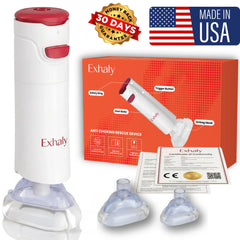
Exhaly Automatic Anti-Choking Rescue Device
Vacuum-based airway clearance device for the home.
$41.99
$60.00
FDA Registered · Made in USA