IF AN OLDER ADULT IS CHOKING RIGHT NOW
1. Can they cough forcefully, speak, or breathe? Stay close and encourage coughing.
2. Cough weak or silent, cannot speak or breathe? Call 911 (UK: 999) or send someone to call.
3. Give 5 back blows, then 5 abdominal thrusts. Repeat until the object comes out.
4. Cannot reach around their abdomen, or the person is pregnant? Give 5 back blows, then 5 chest thrusts.
5. Person goes limp? Lower them to a firm, flat surface and start CPR with chest compressions.
Eating alone is ordinary, and so is the thought that follows it: what if nobody is here? Most choking guidance assumes a helper, someone to give back blows, someone to call. This article covers the one situation where you are both the rescuer and the person who needs rescuing.
Our guide on how to help someone choking covers the full sequence for helping others. Here we stay with the self-rescue methods that reputable sources actually describe, say plainly where they stop, and show how to prepare before you ever need them.
Can You Really Give Yourself the Heimlich Maneuver?
Yes, according to the American Red Cross, Mayo Clinic and Johns Hopkins Medicine, all of which describe abdominal thrusts that you perform on yourself. Johns Hopkins puts it simply: if you are by yourself and choking, you can do thrusts on yourself, or thrust your upper abdomen against the back of a chair or the edge of a counter.
There are two limits worth stating up front. First, no method guarantees success, and the sources do not claim otherwise. Second, the five back blows and five abdominal thrusts that the American Heart Association (AHA) recommends in its 2025 guidelines were written for a rescuer helping someone else. The AHA pages we reviewed do not address self-rescue, so for this situation the sources are the Red Cross, Mayo Clinic and Johns Hopkins. None of them describes a technique for giving yourself back blows, so we will not invent one.
If you can still cough forcefully, keep coughing. The Red Cross tells rescuers to encourage a coughing person to keep going while watching closely, and it is reasonable to apply the same logic to yourself. The hard part of choking alone is that two jobs, getting help and clearing the airway, land on one person. The next section is about the order in which to do them.
Step Zero: Call for Help First, and Keep the Line Open
The Red Cross is specific. If you are choking and alone, call 911 using a landline or a GPS-enabled mobile phone. Even if you are not able to speak, it says, the open line will cause the dispatcher to send help. Mayo Clinic gives the same order: call 911 or your local emergency number right away, then give yourself abdominal thrusts. In the UK, the number is 999.
This is the opposite of the order for helping someone else. Mayo advises a lone rescuer who is helping another person to give back blows and abdominal thrusts first and call afterward. The reason for the difference is our reading, not a quote from the sources: when you are the one choking, you cannot speak, so the open line is the only call you will get to make, and it takes seconds. Whatever the reason, the guidance for self-rescue is clear on the sequence: call, leave the line open, then act.
Method 1: Abdominal Thrusts With Your Fist
This is the method Mayo Clinic describes. The Red Cross also says you can give yourself abdominal thrusts using your hands, just as you would give them to another person.
-
Make a fist. Place the thumb side against your abdomen, slightly above your navel.
-
Grasp your fist with your other hand.
-
Bend over a hard surface. Mayo says a countertop or chair will do.
-
Shove your fist inward and upward in a quick, forceful thrust.
-
Repeat until the object comes out or help arrives.
The sources do not give a number of thrusts for self-rescue, so we will not either. The instruction is to keep going. Think of it as the same movement the rescuer in our guide to the Heimlich maneuver step by step uses on someone else, adapted so that your own hands and a firm surface do the work.
Method 2: Thrusts Against a Firm Object
The Red Cross offers an alternative. Bend over and press your abdomen against any firm object, such as the back of a chair or a railing. It adds two cautions: do not bend over anything with a sharp edge or corner that could hurt you, and be careful when leaning on a railing that is elevated.
The three sources overlap and differ in small ways. This table puts them side by side so you can see what each one says.
|
Source |
Movement described |
What it adds |
|
Mayo Clinic |
Fist above the navel, other hand over it, bend over a hard surface, thrust inward and upward |
Says a countertop or chair will do |
|
American Red Cross |
Thrusts with your hands as you would on another person, or press your abdomen against a firm object |
Avoid sharp edges or corners; take care with elevated railings |
|
Johns Hopkins Medicine |
Thrusts on yourself, or thrust your upper abdomen against a chair back or counter edge |
Use only in real emergencies, when you are sure you are choking |
None of the sources says which method works better, so we will not claim one does. In practice, use whichever one you can start immediately. A counter edge is convenient, but if it is sharp, the Red Cross caution applies and the back of a chair is the safer choice.
If It Does Not Work, and the Cases the Sources Do Not Cover
Keep the line open. The dispatcher knows help is needed, and the sources do not describe any further steps you can take alone beyond continuing the thrusts. If you lose consciousness, there is nothing you can do yourself, which is exactly why the open line matters. The Red Cross says it will cause the dispatcher to send help even if you cannot speak.
Some situations are not covered at all. For rescuers, the Red Cross says to give chest thrusts instead of abdominal thrusts to someone who is pregnant or too large to reach around. We could not find a sourced self-rescue technique for pregnancy or for a body shape where your hands cannot give effective abdominal thrusts, and we will not make one up. If this applies to you, ask a first aid instructor now, before you need the answer, and call emergency services if it happens.
Afterward, get checked. Johns Hopkins advises that anyone who has been given back blows and abdominal thrusts be examined by a healthcare provider as soon as possible, and it is sensible to apply that to yourself even if the object came out and you feel fine.
Before It Happens: Habits and Practice for People Who Eat Alone
Prevention does more than any technique. The Red Cross names several risk factors: talking or laughing with your mouth full, eating too fast, medical conditions that affect chewing or swallowing, and dental problems or poorly fitting dentures. Johns Hopkins adds practical measures for adults: cut food into small pieces, chew slowly and thoroughly (especially if you wear dentures), do not laugh and talk while chewing and swallowing, and avoid drinking a lot of alcohol before and during meals.
Two habits are our own suggestions rather than quotes from a source. Keep your phone within reach at the table, so the call in step zero takes seconds. And if food often feels stuck, or you cough during meals, mention it to your doctor, because difficulty swallowing deserves a proper assessment.
Then there is practice. Mayo Clinic recommends learning the Heimlich maneuver and CPR in a certified first aid course. Ask the instructor to demonstrate the self-rescue methods. Do not test them on yourself at full force: Johns Hopkins advises that thrusts should only be used in actual emergencies when you are sure the person is choking, to minimize possible harm. Ask the instructor how to rehearse safely, for example on a training manikin or by walking through the positions without force. For the wider picture of a prepared home, see our guide to home emergency preparedness.
Where a Suction Device Fits
The self-rescue instructions from the Red Cross, Mayo Clinic and Johns Hopkins do not include a suction device. Resuscitation Council UK, reviewing its position in July 2026, makes no recommendation for or against these devices while it waits for an updated review by the International Liaison Committee on Resuscitation (ILCOR). ILCOR's 2025 first aid update itself says there are currently no treatment recommendations regarding these devices.
Exhaly's product page states that its device is designed to be self-administered: you seal the mask over your own nose and mouth, hold the body in both hands and press the button. That is the manufacturer's description, not a finding from independent research. The same page says the device is intended to be used when standard choking protocols have been followed without success, and that you should always call emergency services (911) first. If you want to look at it, see Exhaly's adult anti-choking rescue device. For a fuller comparison of options and the evidence behind them, read our guide to the best anti choking devices.
Frequently Asked Questions
Can you give yourself back blows?
We could not find a sourced technique for giving yourself back blows. The self-rescue method the Red Cross, Mayo Clinic and Johns Hopkins describe is abdominal thrusts, using your fist or a firm object. We will not invent a technique.
Should I call 911 first or do the thrusts first?
Call first and keep the line open. The Red Cross says the open line will bring help even if you cannot speak, and Mayo Clinic gives the same order for someone choking alone. Then start the thrusts.
What if I can still cough?
If you can cough forcefully, keep coughing. The Red Cross advises rescuers to encourage a person who can cough to keep going while watching closely, and the same logic applies to you. If the cough becomes weak or stops, treat it as severe choking.
What if I am pregnant or cannot reach around my stomach?
The sources do not give a self-rescue technique for these cases, so we cannot give one. Call emergency services, and ask a first aid instructor in advance what to do. For a rescuer helping another person, the Red Cross uses chest thrusts in these situations.
Is a suction device an alternative to the self-Heimlich?
Not according to the guidance we reviewed. The AHA and Red Cross choking steps do not include one, and Resuscitation Council UK makes no recommendation either way. Exhaly describes its device as one you can use on yourself, and says it is for use after standard protocols have failed.
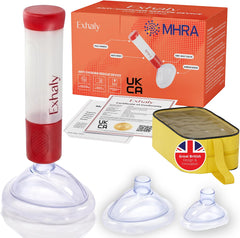
UKCA Marked, Exhaly Anti-Choking Rescue Device
Vacuum-based airway clearance device for the home.
£39.99
£50.00
FDA Registered · Made in USA