IF AN OLDER ADULT IS CHOKING RIGHT NOW
1. Can they cough forcefully, speak, or breathe? Stay close and encourage coughing.
2. Cough weak or silent, cannot speak or breathe? Call 911 (UK: 999) or send someone to call.
3. Give 5 back blows, then 5 abdominal thrusts. Repeat until the object comes out.
4. Cannot reach around their abdomen, or the person is pregnant? Give 5 back blows, then 5 chest thrusts.
5. Person goes limp? Lower them to a firm, flat surface and start CPR with chest compressions.
"Heimlich maneuver" is still the phrase most people type when someone cannot breathe. What current guidance actually teaches is a two-part sequence: five back blows, then five abdominal thrusts, repeated until the object comes out or the person stops responding. The Heimlich maneuver is the second half of that sequence, and the order matters.
This article stays hands-on: where to stand, where your hands go, what changes for a child, a pregnant person or someone in a wheelchair, and the mistakes worth avoiding. For the complete picture, including infants, CPR and when to call, start with our guide on how to help someone choking, which this article builds on. Read both with the people you live with, and if you can, practice in a certified class. Reading about a skill is not the same as being able to do it.
Is the Heimlich Maneuver Still the First Move?
Not quite, and that gap explains a lot of the confusion online. In October 2025 the American Heart Association (AHA) published updated CPR and emergency cardiovascular care guidelines in the journal Circulation. For conscious adults and children, rescuers now alternate five back blows with five abdominal thrusts until the object is expelled or the person becomes unresponsive. The previous guidelines contained no choking guidance for adults, and the guidance for children called for abdominal thrusts only. The American Red Cross teaches the same five-and-five sequence.
Plenty of posters, videos and articles still show abdominal thrusts alone, which is why what you see elsewhere may not match what you read here. We keep "Heimlich maneuver" in the title because it is what people search for, and we keep the content current because the guidance changed.
One practical note. Mayo Clinic's first aid page, updated in August 2025, says it is acceptable to skip back blows if you have never learned the technique. Current AHA guidance asks for both, so the better answer is to learn both.
How to Tell Severe Choking From Mild Choking
Not every cough is an emergency, and acting too early can cause harm. Johns Hopkins Medicine advises using back blows and abdominal thrusts only in real emergencies, when you are sure the person is choking.
If the person can cough forcefully, speak or cry, the airway is not fully blocked. The Red Cross advice here is to encourage them to keep coughing, stay with them and watch closely, ready to act if their condition changes.
Severe choking looks different. The Red Cross lists these signs, and each one calls for immediate emergency treatment:
-
a weak cough or no cough at all
-
high-pitched squeaking sounds, or no sound
-
pale or blue skin
-
inability to cough, speak or cry
-
a panicked, confused or surprised expression
-
one or both hands held to the throat
Do not wait for the skin to turn blue or for the person to collapse. On paper the decision is simple: a strong cough means watch, a weak or silent one means act. In a real emergency it will not feel simple, which is one more reason to practice.
Step by Step: The Current Choking Rescue Sequence (Adult and Child)
These steps follow the American Red Cross instructions for a conscious adult or child who is severely choking, and they match the AHA 2025 sequence. Read them once straight through, then again slowly.
-
Call or send someone to call 911 (UK: 999). If someone else is nearby, send them. If you are alone with the person, put the phone on speaker so you can start helping right away.
-
Position yourself. Stand to the side of the person and slightly behind them. With a small child you may need to kneel behind them instead of standing.
-
Give 5 back blows. Place one arm diagonally across the person's chest and bend them forward at the waist, so their upper body is parallel to the ground. Strike firmly between the shoulder blades with the heel of your hand, five times. Each blow should be separate from the others.
-
Give 5 abdominal thrusts. If the object has not come out, have the person stand up straight. Find their navel with two fingers. Move behind them, put your front foot between their feet and bend your knees slightly for balance. Make a fist with your other hand and place the thumb side against their stomach, above your fingers. Cover that fist with your first hand and pull inward and upward, five times. Make each thrust forceful and separate from the next.
-
Repeat. Keep alternating five back blows and five abdominal thrusts until the object comes out, the person can cough, cry or speak, or the person becomes unresponsive.
-
If the person becomes unresponsive, start CPR. Lower them to a firm, flat surface and begin CPR, starting with chest compressions. Do not sweep the mouth blindly with a finger. The AHA says the risk of making things worse outweighs the benefit. If you are trained, the Red Cross teaches looking in the mouth after each set of compressions and before breaths, removing an object only if you can actually see it.
Under stress, the order is the part people lose, so reduce it to three words: back, belly, repeat. It also helps to know that one round rarely settles things on its own. In its 2025 first aid review, the International Liaison Committee on Resuscitation (ILCOR) noted that, whichever treatment is given first, it is common for more than one intervention to be needed to clear the blockage. If the first set of blows and thrusts does not work, that does not mean you did it wrong. Keep going.
Common Mistakes to Avoid
Waiting is the most costly mistake. Some people watch for the skin to turn blue or for the person to pass out before they act. The Red Cross lists a weak cough, no sound and an inability to speak as signs that need emergency treatment immediately. Call, then help.
Another common one is repeating an older habit: abdominal thrusts only, with no back blows. That is how many people learned it, and many materials still teach it. Current AHA and Red Cross guidance starts with back blows and alternates.
Back blows should be firm and separate, delivered with the heel of the hand between the shoulder blades. Light, rapid patting is not the technique the Red Cross describes.
Do not reach into the mouth blindly. The AHA advises against using your fingers to search the mouth of a choking person, because you can push the object deeper. Resuscitation Council UK gives the same advice and adds that an object should be removed only if it is clearly visible.
Never hold a child upside down by the feet to shake the object loose. The Red Cross says this is not effective and may cause further injury if you drop the child.
Do not interrupt a strong cough. A forceful cough is the body's best tool, so encourage it and keep watching.
Finally, do not invent combinations the guidelines do not describe, such as pressing on the chest and the abdomen at the same time. And do not practice on another person. Learn the technique from a qualified instructor, on a training manikin, because thrusts used when nobody is choking can cause harm.
Special Situations: Children, Pregnancy, Larger Bodies, and Wheelchair Users
Children
A conscious child over one year old gets the same sequence: five back blows, five abdominal thrusts. With a small child, kneel behind them. Mayo Clinic adds that you should use gentle yet firm pressure for a child, to avoid damaging internal organs. The Red Cross pages we reviewed do not set a different force for children, so a class is the best place to get a feel for it.
Pregnancy, and when you cannot reach around the person
The Red Cross says to give chest thrusts instead of abdominal thrusts when a person is too large to wrap your arms around, or is obviously or known to be pregnant. Mayo Clinic describes the hand position: at the base of the breastbone, just above the point where the lowest ribs join, pressing hard into the chest with a quick thrust. Because this is the part of the technique that is easiest to get wrong, we would encourage you to have an instructor show you.
Wheelchair users
For a person in a wheelchair, the Red Cross says to give abdominal thrusts as usual, kneeling behind the chair if you need to. Remove the armrests if necessary. If abdominal thrusts are difficult, give chest thrusts. As a last resort, lift the person out of the chair.
When you are choking alone
You can give abdominal thrusts to yourself, but the order of steps differs, and the sources are different too. We cover it in a separate guide on the Heimlich maneuver on yourself.
Infants
Infants under one year need a different sequence. The AHA recommends alternating five back blows with five chest thrusts, using the heel of one hand, and does not recommend abdominal thrusts for infants because of the risk of injury. For details, see our guide to infant and child choking safety.
After the Object Comes Out
Once the airway is clear, stay on the line with the emergency dispatcher and do what they ask. Johns Hopkins Medicine advises that a person who has been given back blows and abdominal thrusts should be examined by a healthcare provider as soon as possible, whether or not the object came out. Even if they seem fine, let the emergency crew look them over.
Afterwards, consider refreshing your training. The AHA's news coverage of the 2025 update points out that guideline changes are a reason to update CPR and first aid skills from time to time.
Where a Suction Device Fits
Neither the AHA nor the Red Cross steps above include a suction device. Resuscitation Council UK, reviewing its position in July 2026, says it makes no recommendation for or against such devices while it waits for an updated ILCOR review, and stresses that established choking treatments should be prioritized because they can be delivered immediately without equipment.
Some households choose to keep a device as an additional tool anyway. Exhaly's own disclaimer says its device is intended to be used when standard choking protocols have been followed without success, and that you should always call emergency services (911) first. If you want to look at it, see Exhaly's adult-size anti-choking rescue device. To compare options, read our guide to the best anti choking devices. Nothing about a device changes the sequence above.
Frequently Asked Questions
What is the Heimlich maneuver?
It is another name for abdominal thrusts: standing behind a person and pulling inward and upward just above the navel. The AHA now describes it as "what has been called the Heimlich maneuver," and teaches it as one half of a five-and-five sequence with back blows.
Do you do back blows or abdominal thrusts first?
Back blows first. Both the AHA (2025) and the Red Cross start with five back blows, then give five abdominal thrusts, and alternate.
How many abdominal thrusts do you give?
Five at a time, then back to five back blows. Continue alternating until the object comes out, the person can cough, cry or speak, or they become unresponsive.
Can you do the Heimlich maneuver on a child?
Yes, for a child over one year old, using the same sequence. With a small child you may need to kneel behind them. Do not use abdominal thrusts on a baby under one year. Babies need five back blows and five chest thrusts, covered in our guide to infant and child choking safety.
What if the person becomes unresponsive?
Lower them to a firm, flat surface and start CPR with chest compressions. Do not search the mouth blindly with your fingers. If you are trained, remove an object only if you can see it.
Can I do the Heimlich maneuver on myself?
Yes. The Red Cross, Mayo Clinic and Johns Hopkins all describe self-administered abdominal thrusts, and the Red Cross and Mayo say to call 911 first. We cover the methods and their limits in our guide to the Heimlich maneuver on yourself.
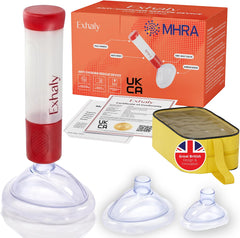
UKCA Marked, Exhaly Anti-Choking Rescue Device
Vacuum-based airway clearance device for the home.
£39.99
£50.00
FDA Registered · Made in USA