IF AN OLDER ADULT IS CHOKING RIGHT NOW
1. Can they cough forcefully, speak, or breathe? Stay close and encourage coughing.
2. Cough weak or silent, cannot speak or breathe? Call 911 (UK: 999) or send someone to call.
3. Give 5 back blows, then 5 abdominal thrusts. Repeat until the object comes out.
4. Cannot reach around their abdomen, or the person is pregnant? Give 5 back blows, then 5 chest thrusts.
5. Person goes limp? Lower them to a firm, flat surface and start CPR with chest compressions.
Home emergency preparedness is often reduced to buying a first aid kit, storing a few emergency supplies, and hoping they will be available when needed. In practice, preparedness is much more about organization than ownership.
A prepared household has already thought about who knows first aid, how emergency services will be contacted, where important information and supplies are kept, and whether anyone in the home has needs that change the response to an emergency.
Choking is a useful example because it combines prevention, recognition, immediate action, and emergency communication. There may be very little time to decide what to do once a severe airway obstruction occurs.
A practical home emergency preparedness checklist should therefore help reduce avoidable confusion before an emergency happens. It cannot guarantee a safe outcome, but it can make the household better organized to respond.
Emergency Safety Notice
If someone cannot breathe, speak, cry, or cough effectively because of suspected choking, call 911 in the United States and begin age-appropriate choking first aid according to current guidance. Do not delay established first aid while looking for emergency equipment.
This guide is intended for preparedness and education. It does not replace certified first aid or CPR training.
What Does a Choking-Ready Household Actually Mean?
A choking-ready home is not simply a home that owns a rescue device.
A better model has five connected layers: prevention, recognition, skills, communication, and equipment.
Prevention means reducing foreseeable hazards. Recognition means understanding when ordinary coughing has progressed to severe airway obstruction. Skills include knowing the appropriate first aid response and having people in the household who are comfortable activating emergency services.
Communication ensures that 911, relevant medical information, and caregiver contacts can be accessed quickly. Equipment includes ordinary first aid supplies and any supplementary emergency products the household has decided are appropriate.
The final element connecting all five layers is familiarity. Everyone who may need to respond should know where important supplies are located and what role they serve.
A household with expensive emergency products but nobody who knows how to respond to severe choking is not necessarily well prepared.
Start With the People Who Actually Live in Your Home
There is no universal emergency preparedness plan that fits every family.
Begin by considering who lives in the household and how those circumstances affect risk.
Families With Babies and Young Children
Young children have particular choking risks because feeding abilities develop gradually and children frequently explore objects by placing them in their mouths.
Preparedness changes as a child develops.
A household with a newborn has different priorities from one with a crawling infant who can reach objects on the floor. A toddler beginning to eat a wider range of foods introduces another set of considerations.
Parents should pay attention to age-appropriate food preparation, small toy components, coins, balloons, batteries, and objects that older siblings may leave within reach.
The home should evolve with the child rather than relying on a safety check performed only once.
Homes With Older Adults
Older age alone does not mean someone will experience choking.
However, known swallowing difficulties, neurological conditions, changes in chewing ability, poorly fitting dentures, cognitive impairment, or limitations affecting eating position may change how a household approaches mealtimes and emergency planning.
People with diagnosed dysphagia should follow individualized clinical recommendations rather than generic internet feeding rules.
Someone Living Alone
Living alone changes the response model completely.
There may be nobody nearby to notice severe choking, call emergency services, perform first aid, or retrieve supplies.
For someone living alone, communication access and familiarity with recognized self-rescue guidance become especially important. Emergency equipment, if kept in the home, also needs to be accessible to the individual rather than stored somewhere that assumes a second person will retrieve it.
Create a Family Emergency Response Plan
Emergency plans do not need to be complicated.
Their main purpose is to prevent several people from standing in the same room wondering who is doing what.
If multiple adults are present during an emergency, one person may begin appropriate first aid while another calls 911. Someone else may supervise children, retrieve requested supplies, or meet emergency responders.
These roles do not need to be rigid. Circumstances will vary.
The useful part is discussing them before they are needed.
Emergency contact information should also be easy to find. Important numbers and relevant medical details should not exist only inside one person's locked phone.
A printed emergency card on a refrigerator or another known location can contain key contacts, pediatrician or physician information where relevant, allergy or medication information that emergency responders may need, and numbers for family members or caregivers.
Babysitters, grandparents, and other people who regularly care for children should know where this information is located.
Families do not need to stage frightening emergency simulations. Simply discussing the plan periodically can build useful familiarity.
Learn Choking First Aid Before You Need It
Equipment is easier to buy than skill, but skill remains more important.
Recognized first aid and CPR education gives people an opportunity to practice positioning, understand changes in responsiveness, and receive feedback that cannot be reproduced completely by reading an article.
Current 2025 American Heart Association guidance recommends that a responsive adult with severe foreign-body airway obstruction receive repeated cycles of five back blows followed by five abdominal thrusts until the object is expelled or the person becomes unresponsive.
Infants require a different procedure using back blows and chest thrusts rather than abdominal thrusts.
If the person becomes unresponsive, the response changes to CPR.
The detailed procedures should be learned through current instruction. Readers who want to understand the clinical basis can also consult the 2025 AHA Adult Basic Life Support Guidelines.
For a broader practical overview covering adults, children, infants, prevention, and emergency response, Exhaly's complete choking safety and first aid guide provides additional context.
The important household principle is simple: do not wait until someone is choking to learn what severe airway obstruction looks like.
Make the Kitchen Safer Before Thinking About Emergency Equipment
The kitchen and dining area are among the most important parts of a choking preparedness plan because prevention starts long before first aid becomes necessary.
Food should match the person's developmental and functional abilities.
For young children, shape, size, texture, and preparation matter. Whole grapes, round pieces of sausage, hard candy, popcorn, nuts, hard pieces of raw vegetables, tough meat, and thick spoonfuls of nut butter are examples of foods that may require avoidance or modification depending on the child's age and development.
Mealtime behavior matters as well.
Young children should eat while seated rather than walking, running, crawling, or lying down. Meals should allow enough time for chewing and swallowing instead of being rushed.
Active supervision is more useful than simply preparing food correctly and assuming the risk has disappeared.
The same individualized thinking applies to older adults.
Someone with known swallowing difficulties may have specific recommendations about positioning, assistance, food consistency, or pacing. Families should not independently switch every older relative to soft foods or thickened liquids simply because of age.
A safer kitchen is therefore less about banning foods and more about matching eating conditions to the person.
Choking Hazards Exist Beyond the Dining Table
Household choking prevention also means looking at what can reach the mouth outside mealtimes.
Coins, marbles, small balls, pen caps, detachable accessories, and small toy components can migrate into places adults do not immediately notice. Objects dropped by older siblings may end up under furniture, between sofa cushions, or on the floor where a younger child can reach them.
Toys should be selected according to appropriate age guidance and periodically inspected for components that may have loosened or broken.
Balloons deserve particular attention. Uninflated balloons and fragments of broken balloons can present a choking hazard to children.
Button batteries are different.
Swallowing a button battery can cause serious internal injury even when the airway is not obstructed. Suspected battery ingestion requires urgent medical guidance and should not automatically trigger choking maneuvers when the person is breathing normally.
A useful household habit is to periodically view rooms from the perspective of the youngest or most vulnerable person living there.
What Should Be in a Home First Aid Kit?
A first aid kit should support common household injuries and emergency response, but it should not be confused with a universal treatment box.
Useful categories include adhesive bandages, sterile gauze, roller bandages, adhesive tape, antiseptic supplies, nonlatex gloves, a cold compress, tweezers, an emergency blanket, a CPR breathing barrier, a thermometer, and basic first aid instructions.
Personal needs may require additional items.
A household member may have prescribed emergency medication, important allergy information, diabetes supplies, or other items recommended by a healthcare professional.
The kit should reflect those realities rather than an internet shopping list.
It is equally important to understand what a first aid kit cannot do.
Bandages do not resolve an airway obstruction. A breathing barrier does not replace knowing CPR. Owning medical supplies does not mean someone knows when or how to use them.
First aid kits also require maintenance. Used supplies need replacement, packaging can become damaged, and some products expire.
Checking the kit periodically is part of preparedness rather than an optional housekeeping task.
Where Should Emergency Supplies Be Stored?
An emergency product that nobody can find is of limited value.
Choose a central location that responsible adults can access quickly. The location should also protect children from items that are unsafe for unsupervised use.
Avoid storing important equipment somewhere that requires an obscure key, is hidden behind rarely used household items, or exposes it to heat or moisture contrary to its storage instructions.
Regular caregivers should know where the first aid kit and other emergency supplies are kept.
A large home may reasonably have more than one basic kit, but duplicating products in every room does not automatically improve safety.
Accessibility should be planned rather than maximized indiscriminately.
Where Do Anti-Choking Devices Fit Into a Home Emergency Plan?
Some households choose to keep suction-based anti-choking equipment as an additional emergency preparedness option.
It is important to place that decision in the correct order.
Current FDA guidance states that established choking rescue procedures should be followed first. Supplementary airway-clearance devices may be considered when standard procedures have not successfully relieved the obstruction.
The device should therefore not be stored or discussed as though it replaces first aid.
If a household decides to keep one, practical questions matter: Is the product easy to locate? Do household adults understand how it operates? Are the correct masks and components available? Have the instructions been reviewed before an emergency? Are storage and replacement recommendations being followed?
A device sitting unopened in an unfamiliar box is less useful than equipment household members understand.
For families considering a mechanically automatic suction option as one element of this broader preparedness system, the Exhaly Automatic Anti-Choking Rescue Device can be evaluated alongside the household's existing first aid knowledge and emergency plan.
The key word is supplementary.
A choking-ready household is defined by the system around the equipment, not by the equipment alone.
Preparedness for New Parents Should Evolve Quickly
New parents often prepare extensively for feeding, sleep, transportation, and hygiene but may give emergency planning less attention.
A few practical preparations can make the transition easier.
Parents and regular caregivers should understand infant choking recognition, pediatric CPR, and current infant first aid. Emergency information should be accessible to grandparents and babysitters.
As complementary foods begin, food preparation becomes a new part of the safety plan.
When the baby starts crawling, environmental hazards become more important.
Later, toddler independence changes the picture again.
Instead of trying to create a permanently “baby-proof” home before birth, preparedness should be treated as something that develops alongside the child.
Build a Simple Monthly Preparedness Routine
Emergency preparedness works better as a small recurring habit than as a large project completed once.
Every month or two, check whether first aid supplies have been used, whether emergency contacts are still current, and whether important equipment remains accessible.
Look for new hazards created by changes in the household.
A crawling child, a visiting grandparent, a new caregiver, a change in an older adult's swallowing ability, or a move to a different room can all change what needs attention.
Every six months, review first aid and CPR knowledge, product instructions, expiration dates, and household responsibilities.
After any significant emergency, review what actually happened.
Were supplies easy to find? Was someone able to call for help quickly? Did everyone understand their role? Has the event revealed a new medical or environmental risk?
The purpose is improvement, not blame.
Home Emergency Preparedness Checklist
A useful choking-ready household should be able to answer yes to most of the following:
Knowledge and skills: Household adults recognize severe choking, understand that infants require different first aid, and know how to access current CPR and first aid training.
Communication: 911 can be contacted quickly, emergency contacts are available outside a single locked phone, and regular caregivers know where important information is stored.
Prevention: Food preparation reflects age and ability, young children are supervised during eating, small household hazards are periodically checked, and known swallowing problems follow an individualized care plan.
Supplies: The first aid kit is accessible, used or expired supplies are replaced, and any specialized equipment is stored according to instructions.
Practice: Household responsibilities have been discussed, new caregivers receive relevant information, and the plan is reviewed as family circumstances change.
No checklist needs to contain “own an anti-choking device” as a mandatory requirement.
If supplementary equipment is kept in the home, the more meaningful question is whether household members understand its purpose, instructions, storage, and place within established first aid.
Frequently Asked Questions
What should be included in a home emergency preparedness plan?
Include emergency communication, household responsibilities, basic first aid knowledge, accessible medical information, risk reduction, suitable supplies, and a plan for reviewing these elements periodically.
Where should a first aid kit be stored?
Choose a location that responsible adults and regular caregivers can identify quickly while keeping unsafe components away from children. Follow storage requirements for any temperature- or moisture-sensitive products.
What should I keep in the kitchen for a choking emergency?
Reliable phone access, emergency contact information, first aid knowledge, and appropriately selected emergency supplies are more important than improvised kitchen tools. Never use tongs, utensils, or blind finger sweeps to search the airway.
Should everyone in the family learn choking first aid?
Households benefit when more than one capable person understands emergency response. Practical training through recognized providers is preferable to relying entirely on written instructions.
Should every home have an anti-choking device?
There is no universal recommendation that every household must own one. It is a supplementary preparedness decision that should be considered alongside first aid knowledge, household needs, accessibility, and product instructions.
How often should emergency supplies be checked?
A brief review every month or two is practical for many households, with a more thorough inspection periodically and whenever supplies are used, expire, or household circumstances change.
Preparedness Is a System, Not a Product
A choking-ready household is not the home with the largest collection of emergency equipment.
It is the home where foreseeable hazards are reduced, household members understand severe choking, emergency services can be contacted quickly, first aid skills have been considered before they are needed, and essential supplies can actually be found.
Different households will require different arrangements.
A family with a toddler, an adult living alone, and a household supporting someone with dysphagia should not have identical preparedness plans.
Start with the people in the home, identify the most meaningful gaps, and improve the system one step at a time.
Good preparedness should make a household more organized—not more afraid.
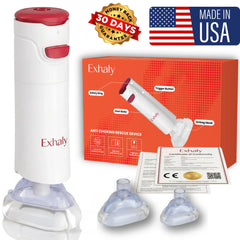
Exhaly Automatic Anti-Choking Rescue Device
Vacuum-based airway clearance device for the home.
$41.99
$60.00
FDA Registered · Made in USA